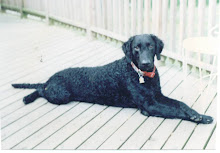
As I was reflecting on days gone by, I happened to recall the Babe and her uncanny ability to climb trees. Earlier in this blog I wrote a hunt test tale entitled "She Climbs Trees" and as this is a second incident, I guess "She did it again" is an appropriate title. As I recall . . .
I was sitting on the steps that lead into the puppy yard, musing at my grass, (yes it came back) when Singer went under the azalea bush beside the steps. You might think of a small, compact flowering bush when the word "azalea" is mentioned, but this one was well over 12 feet tall and probably a good 8 feet wide, so it was more like a tree than a bush. It was lovely when it bloomed, all white.
She nosed her way to the trunk and started pushing on the limbs. I thought that she wanted to rub against the branches to "scratch" some hard to reach spots. But no, she was staring intently up into the branches.
Then she put her right, front paw on the branch followed by her left paw while moving her right paw further up to another branch. She then put a rear paw on the lowest branch as the other paws moved up. She was stretched like a gymnast reaching for the upper parallel bar, then drat, she fell.
Undaunted, she started over. Still looking strait up into the branches, she moved her first paw, second paw, third paw . . . and this time she got her fourth paw off the ground, then drat, she fell again.
Still undaunted she started over. On her third try she solidly got that fourth paw onto a branch, then continued her upward movement, one paw at a time. This was a circular climb as the bush had a trunk about 3" thick with close set branches. She continued to stretch for ?something? above, just out of reach of her nose.
All the while, as I marveled at her tenacity, I wondered what could possible be in the bush that she wanted so badly. I could not come up with anything positive, but plenty of negative thoughts plagued me so I decided it might be wise to intervene.
"SINGER! GET OUT OF THAT TREE !!!"
Gingerly, she reversed her paw action and down she came. I searched the bush for birds . . . nests . . . frightened or injured animals . . . snakes, but I found nothing. Nothing but a few dead leaves in the crook of a branch that appeared to be composting. Ah yes, the delicious smell of compost, that must have been it.
This incident took place around 1999 when Singer was two and a half years old. She was a hearty girl, full of spirit and the type that would never give up. Maybe that was why she was so special to me.
Hunter

A true gentleman
Showing posts with label Curly-coated Retriever. Show all posts
Showing posts with label Curly-coated Retriever. Show all posts
Tuesday, April 3, 2012

Sunday, July 11, 2010
The Meet and Greet Committee (of one).
Having just moved my office into a new building, I didn't know anyone there. Whenever I went to work after hours, I would take Hunter with me to keep me company and stand guard. One day, I was working away when I noticed that Hunter was not laying by my desk. I got up to check on him and had one of those 'uhoh' moments . . . the door to the hall was open and Hunter was gone. I took off down the hall to find him and that's when I heard it . . . laughter!
I followed the laughter around a corner and found another open office door. I walked in, passed into an inner office and there he was, chowing down on a cheesburger that was laying on the corner of the desk.
"Hunter!" I gasped. He looked up at the sound of his name but he didn't budge from his cheeseburger. Two guys were sitting on the edge of another desk laughing at him. I rushed in, spewing apologies, and went to grab his collar, but they stopped me. "We told him he could have it" one of them said in his defense.
As the story goes, they had just come in with take-out from McDonald's. The boss set his burger down on the edge of his desk and stepped away for something. When he looked up, there was a "huge black dog" standing in the doorway. Nobody moved. The dog walked in and went strait to the cheeseburger. Then, he looked up at its owner with a meaningful look in his eyes as if to say "may I?". The guy told him it was ok, he could have it, at which point, Hunter began to eat it. They started laughing and that is when I came in.
We stood around and talked while Hunter finished eating and swapped names and small talk. Tammy, from the outer office came in to meet him and became Hunter's instant friend. He never came back to work with me that he didn't have to go visit Aunt Tammy. Maybe he was looking for cheeseburgers, but he always found her.
That first meeting could have gone either way. Luckily for Hunter and me, our office mates had a great sense of humor and probably relished the tale they got to go home and tell their kids . . . about the big black dog that appeared like magic and ate their cheeseburger!!!
I followed the laughter around a corner and found another open office door. I walked in, passed into an inner office and there he was, chowing down on a cheesburger that was laying on the corner of the desk.
"Hunter!" I gasped. He looked up at the sound of his name but he didn't budge from his cheeseburger. Two guys were sitting on the edge of another desk laughing at him. I rushed in, spewing apologies, and went to grab his collar, but they stopped me. "We told him he could have it" one of them said in his defense.
As the story goes, they had just come in with take-out from McDonald's. The boss set his burger down on the edge of his desk and stepped away for something. When he looked up, there was a "huge black dog" standing in the doorway. Nobody moved. The dog walked in and went strait to the cheeseburger. Then, he looked up at its owner with a meaningful look in his eyes as if to say "may I?". The guy told him it was ok, he could have it, at which point, Hunter began to eat it. They started laughing and that is when I came in.
We stood around and talked while Hunter finished eating and swapped names and small talk. Tammy, from the outer office came in to meet him and became Hunter's instant friend. He never came back to work with me that he didn't have to go visit Aunt Tammy. Maybe he was looking for cheeseburgers, but he always found her.
That first meeting could have gone either way. Luckily for Hunter and me, our office mates had a great sense of humor and probably relished the tale they got to go home and tell their kids . . . about the big black dog that appeared like magic and ate their cheeseburger!!!
Monday, March 15, 2010
Sometimes It’s Good To Be Bad
Some years ago, on one of our hunting expeditions to the Beaver Pond, the infamous ‘secret spot’ whose location Dennis guarded closely (so don’t ask where it is), we found ourselves with a lot of time to kill between duck sightings.
We’d used up all of our conversation topics and Hunter, my Curly-Coated Retriever, had had his fill of being tended, so I decided to practice my duck calling. I had watched the Buck Gardner tapes, practiced calling, watched the tapes and practiced some more, but I still wasn’t very good. I thought I had a pretty good ‘feeding chuckle’ so I started my practice with that one. It was supposed to sound like happy ducks.
A few minutes into practice, Dennis directed my attention skyward to a pair of dark blips heading in our direction. I continued to chuckle. The blips were flying in tandem (chuckle, chuckle), in a slow, gentle rocking motion (chuckle, chuckle), side to side (chuckle, chuckle), as though swinging on the same invisible cord suspended from Heaven (chuckle, chuckle), and they were heading strait for us (chuckle, chuckle). As they neared, it became apparent that we were watching a pair of young, Bald Eagles making their way to our pond, possibly looking for the floundering duck they had heard there. I put my duck call down.
We sat silently, stone still as the pair flew to within 20 or so yards above us, directly over the center of our pond. Then with a breathtaking swiftness, the pair flew together, feet first and locked talons. And, while still gripping one another, began a maddening free fall towards the water. Talons still clutched and within inches of crashing into the water, the pair of Eagles pushed off of each other, flying in opposite directions, outward, mere inches above the water’s surface, then upwards in a graceful arc, rejoining one another at the top of the arc at their original point of contact. It was a Magnificent sight!
Then, side by side they lazily continued on their journey, gently ebbing and flowing on the wind until they were tiny specks on the horizon. Only then did we move, looking at each other, as though to make sure that we both saw what we thought we had seen. Hunter hadn't flinched the entire time, as though he knew the moment was unique.
The game warden later said that we had witnessed a rarely seen, mating ritual. It was the most special “hunting” moment I have ever had.
Now mind you, the Eagles may have come to our Beaver Pond on their own, with us just being in the right place at the right time. But I like to think that I "called" the Eagles to us with my special duck calling.
Yes, sometimes, it is good to be bad.
We’d used up all of our conversation topics and Hunter, my Curly-Coated Retriever, had had his fill of being tended, so I decided to practice my duck calling. I had watched the Buck Gardner tapes, practiced calling, watched the tapes and practiced some more, but I still wasn’t very good. I thought I had a pretty good ‘feeding chuckle’ so I started my practice with that one. It was supposed to sound like happy ducks.
A few minutes into practice, Dennis directed my attention skyward to a pair of dark blips heading in our direction. I continued to chuckle. The blips were flying in tandem (chuckle, chuckle), in a slow, gentle rocking motion (chuckle, chuckle), side to side (chuckle, chuckle), as though swinging on the same invisible cord suspended from Heaven (chuckle, chuckle), and they were heading strait for us (chuckle, chuckle). As they neared, it became apparent that we were watching a pair of young, Bald Eagles making their way to our pond, possibly looking for the floundering duck they had heard there. I put my duck call down.
We sat silently, stone still as the pair flew to within 20 or so yards above us, directly over the center of our pond. Then with a breathtaking swiftness, the pair flew together, feet first and locked talons. And, while still gripping one another, began a maddening free fall towards the water. Talons still clutched and within inches of crashing into the water, the pair of Eagles pushed off of each other, flying in opposite directions, outward, mere inches above the water’s surface, then upwards in a graceful arc, rejoining one another at the top of the arc at their original point of contact. It was a Magnificent sight!
Then, side by side they lazily continued on their journey, gently ebbing and flowing on the wind until they were tiny specks on the horizon. Only then did we move, looking at each other, as though to make sure that we both saw what we thought we had seen. Hunter hadn't flinched the entire time, as though he knew the moment was unique.
The game warden later said that we had witnessed a rarely seen, mating ritual. It was the most special “hunting” moment I have ever had.
Now mind you, the Eagles may have come to our Beaver Pond on their own, with us just being in the right place at the right time. But I like to think that I "called" the Eagles to us with my special duck calling.
Yes, sometimes, it is good to be bad.
Sunday, January 25, 2009
The perils of training blinds.
Training for blind work with Hunter, my Curly-Coated Retriever, was never ordinary. The theory is that you set up your training scenarios and run through them. Simple, right? Well, it was rarely simple for us. When I would set up blind drills, things usually happened.
On more than one occasion, as Hunter was swimming across the pond in the direction I had sent him, someone else's bumper that had been underwater, stuck in the mud, would just pop up in front of him. Naturally, he would think that I was sending him for the unexpected bumper so he would get it and return to me. I usually saw those and rarely tried to correct him for stopping early. We would then move on and set up something else to try to accomplish what I had originally intended to work on.
Often when we would train for land blinds, he would find someone's lost bumper in the grass, and again, he would retrieve that one and think his job was done. The problem with unexpected bumpers was that I didn't know they were there and couldn't see them right away, so often I confused him with more commands when he stopped prematurely. Since we were training blinds, I had to accept his find and let him think he did the right thing (which technically he did - he went out cold to a place he didn't choose to go and brought back his bumper).
The absolute worst training snafu, however, occurred on a pond we used to use all the time. I had sent Hunter toward the far bank on a line where he would have to swim past a point and push to the far side. As he neared the point, however, a Mama duck with her string of little ducklings swam across his path a few yards ahead of him and clearly, Mama duck knew he was there and was hurrying her crew as fast as she could. Hunter stayed on his line until it crossed the ducks' path then he took a hard left and began pursuit of the family.
I blew my whistle, I called him to come in, (I really didn't want him to traumatize a baby duck) but Hunter kept pursuing them, and he was gaining on them. None of my usual training commands were working. After all, I usually used those commands to put him on to ducks. And I'm sure in his mind, he knew that I meant for him to get that duck before he came in. It was right there.
As a last resort and with less than a yard to go before he caught up with the last straggling duckling, I pulled out one of my obedience commands and yelled "HUNTER, LEAVE IT!"
Like magic, he dropped his pursuit and swung around to face me, confused as to why I no longer wanted the ducks, but willing to obey the command. I yelled "Good Boy!" and "Hunter Come!" And to his credit, he headed toward me.
We had used that pond to train many times before and there had never been ducks there. Nor have there been ducks there since. Oh well, when you were out with Hunter, you learned to expect the unexpected.
Q & A for the day:
Why is it important to train for blinds?
A well trained retriever is a great conservation tool. He will retrieve each bird down and the hunter can take his limit.
Sometimes, when the dog is retrieving a downed bird, the hunter will shoot another one and the dog will have no idea where the second one fell. When the dog returns with his bird, the hunter will send him to the second bird. With training, the hunter can set the dog up, pointing him in the right direction and send him "back" toward the bird. Using a series of whistles and hand signals, the hunter can steer the dog to the spot of the fall. If the wind is in his favor, the dog's nose will guide him in, if not, the hunter can guide him to the fall.
The blind is first taught up close, then distance is added. You get quite a feeling of achievement when you and your dog communicate well enough to achieve the goal.
On more than one occasion, as Hunter was swimming across the pond in the direction I had sent him, someone else's bumper that had been underwater, stuck in the mud, would just pop up in front of him. Naturally, he would think that I was sending him for the unexpected bumper so he would get it and return to me. I usually saw those and rarely tried to correct him for stopping early. We would then move on and set up something else to try to accomplish what I had originally intended to work on.
Often when we would train for land blinds, he would find someone's lost bumper in the grass, and again, he would retrieve that one and think his job was done. The problem with unexpected bumpers was that I didn't know they were there and couldn't see them right away, so often I confused him with more commands when he stopped prematurely. Since we were training blinds, I had to accept his find and let him think he did the right thing (which technically he did - he went out cold to a place he didn't choose to go and brought back his bumper).
The absolute worst training snafu, however, occurred on a pond we used to use all the time. I had sent Hunter toward the far bank on a line where he would have to swim past a point and push to the far side. As he neared the point, however, a Mama duck with her string of little ducklings swam across his path a few yards ahead of him and clearly, Mama duck knew he was there and was hurrying her crew as fast as she could. Hunter stayed on his line until it crossed the ducks' path then he took a hard left and began pursuit of the family.
I blew my whistle, I called him to come in, (I really didn't want him to traumatize a baby duck) but Hunter kept pursuing them, and he was gaining on them. None of my usual training commands were working. After all, I usually used those commands to put him on to ducks. And I'm sure in his mind, he knew that I meant for him to get that duck before he came in. It was right there.
As a last resort and with less than a yard to go before he caught up with the last straggling duckling, I pulled out one of my obedience commands and yelled "HUNTER, LEAVE IT!"
Like magic, he dropped his pursuit and swung around to face me, confused as to why I no longer wanted the ducks, but willing to obey the command. I yelled "Good Boy!" and "Hunter Come!" And to his credit, he headed toward me.
We had used that pond to train many times before and there had never been ducks there. Nor have there been ducks there since. Oh well, when you were out with Hunter, you learned to expect the unexpected.
Q & A for the day:
Why is it important to train for blinds?
A well trained retriever is a great conservation tool. He will retrieve each bird down and the hunter can take his limit.
Sometimes, when the dog is retrieving a downed bird, the hunter will shoot another one and the dog will have no idea where the second one fell. When the dog returns with his bird, the hunter will send him to the second bird. With training, the hunter can set the dog up, pointing him in the right direction and send him "back" toward the bird. Using a series of whistles and hand signals, the hunter can steer the dog to the spot of the fall. If the wind is in his favor, the dog's nose will guide him in, if not, the hunter can guide him to the fall.
The blind is first taught up close, then distance is added. You get quite a feeling of achievement when you and your dog communicate well enough to achieve the goal.
Saturday, June 14, 2008
Needed - longer arms.
One of the perks of owning Curly-Coated Retrievers is the type of games you can play with them. Hunter, my first CCR introduced me to the fun of field training. I joined a great group of folks who had trained other retriever breeds for many years and they were very patient in teaching me the ropes. After awhile, I found the confidence to go out by myself to work on drills.
On one particular occasion, Hunter took extreme advantage of the pond in between us. I had sent him on a blind retrieve across the pond (several bumpers were already placed on the other side so he would see no bumper fall). When he got to the other side, however, he must have figured out that my arms weren't long enough to reach him so he could do as he pleased. And he did. He investigated every interesting smell he could find and peed on lots of things. He was having such a good time that he failed to notice that I was trotting around the pond.
He was so intent on investigating his latest find that until I said "Hunter, Heel!" from two feet away, he didn't even know I was there.
I know I've mentioned his "Oh S#!#!" look before, but this was the first time I ever saw it. He looked directly into my eyes and I could read his mind. He knew that he was in trouble and he instantly tried to fix it by snatching up his bumper and jumping into the pond, heading strait back to the spot where I had been standing on the opposite bank.
"Oh no you don't", I said and I called him to heel. To his credit he came out of the water, tail tucked between his legs and he slunk over to where I stood. He looked so pitiful standing there, dripping wet. He didn't even shake. He knew he was caught. A guilty conscience goes a long way with this dog. And before you wonder, "does he act that way because you beat him?" I can say absolutely not!! We train with praise! Besides, unless you can administer a correction simultaneously with the mis-deed, you may as well save it because the belated correction is totally useless as a teaching tool.
I was having a bit of difficulty not laughing at him so I decided to let him off the hook and put him back to work. I made him hold his bumper and sat him at the edge of the pond. Then I walked back around the pond to my original spot, faced him and from across the water I called, "Hunter Come!"
Now I had great visions of Hunter plunging into the water and swimming to me in a direct line, as he should have done to begin with. Instead, at my call, he took a sharp right turn and ran around the pond in the exact route that I had just taken.
Oh well, I was training blinds, not bank running so I held my tongue since he technically obeyed the command I had given him. After this episode, I decided that we needed to end the training session on a good note so I set him up again, held my breath and sent him "Back" across the pond for the last bumper. This time, he hit the water, swam across, picked up the bumper, turned and swam strait back to me.
Good dog!
Q & A for the day:
Hmmm, two good topics for this one so I'll pick the one folks have the most trouble recognizing - timing the praise or correction.
What do you mean, timing the praise or correction is everything?
I'll start with an example, you are teaching your dog to sit . . . he is right in front of you and you tell him to "sit" . . . and for the first time, his bottom hits the floor . . . you are sooooo excited that you throw your hands up in the air and clap . . . he experiences your delight and jumps up to celebrate with you . . . and you say "Good Dog".
You have just praised your dog for jumping up, not sitting. So the next time you want him to sit, he will remember how much praise he got when you said "sit" for jumping up and he will try to give you the jumping up behavior that he found most rewarding. He won't want to sit.
He's not a 'dumb dog' that can't learn to sit, he is a smart dog that learned what gets him praise and he repeats the action that got it for him. To reinforce the sit behavior, you must administer the praise while his bottom is still on the ground - it takes only seconds to miss the opportunity to praise correctly so you must be ready. If you miss it, say nothing, and try again.
It also helps to know that a dog's attention span for learning new activities can be counted in seconds, 5 - 10 seconds max, depending on age. So if you want to correct him for a misdeed, he must be doing the misdeed at the time of the correction. If you catch him chewing a chair leg, tell him "no chew" or "bad chew" and give him something appropriate to chew on, then follow up with a "good chew" - or whatever words you choose to use. Choice of word doesn't matter as long as you are consistent - it is the voice, not the word that counts - but command consistency helps during the learning process.
This is also why house training can take so long for some dogs. They don't associate a correction received well after the deed is done with actually doing the deed in the house. And shoving his nose in the pile doesn't help - he no longer associates an old pile with the 'doing of the deed'. That is why a crate is very useful in house training. The dog is contained in his den until you can escort him outside - then GO with him so that you can praise his doing the deed outside where you want it. Afterwards, keep a close eye on him and if he starts sniffing around the room, take him out again and if he performs praise him again. In house training, diligence is everything.
Be careful that you don't fall into the house training trap of training the dog to use the revolving door. If you let him out the door, he pees and comes back in, then gets a cookie, no matter what you are saying, in his mind he is being praised for coming inside - not peeing outside. That's why some dogs have to "go" so often - they are really going outside so that they can come right back inside and get a cookie :-). This is exactly why you need to go outside with the dog - so that you can give praise for the correct behavior - peeing, not coming in the door - the praise always comes outside. Lots of folks have spent lots of dollars going to the vet to make sure their dog doesn't have an infection because they always have to 'go'.
You will be amazed at the results you can get if you remember the proper use of these two words: "timing and praise".
On one particular occasion, Hunter took extreme advantage of the pond in between us. I had sent him on a blind retrieve across the pond (several bumpers were already placed on the other side so he would see no bumper fall). When he got to the other side, however, he must have figured out that my arms weren't long enough to reach him so he could do as he pleased. And he did. He investigated every interesting smell he could find and peed on lots of things. He was having such a good time that he failed to notice that I was trotting around the pond.
He was so intent on investigating his latest find that until I said "Hunter, Heel!" from two feet away, he didn't even know I was there.
I know I've mentioned his "Oh S#!#!" look before, but this was the first time I ever saw it. He looked directly into my eyes and I could read his mind. He knew that he was in trouble and he instantly tried to fix it by snatching up his bumper and jumping into the pond, heading strait back to the spot where I had been standing on the opposite bank.
"Oh no you don't", I said and I called him to heel. To his credit he came out of the water, tail tucked between his legs and he slunk over to where I stood. He looked so pitiful standing there, dripping wet. He didn't even shake. He knew he was caught. A guilty conscience goes a long way with this dog. And before you wonder, "does he act that way because you beat him?" I can say absolutely not!! We train with praise! Besides, unless you can administer a correction simultaneously with the mis-deed, you may as well save it because the belated correction is totally useless as a teaching tool.
I was having a bit of difficulty not laughing at him so I decided to let him off the hook and put him back to work. I made him hold his bumper and sat him at the edge of the pond. Then I walked back around the pond to my original spot, faced him and from across the water I called, "Hunter Come!"
Now I had great visions of Hunter plunging into the water and swimming to me in a direct line, as he should have done to begin with. Instead, at my call, he took a sharp right turn and ran around the pond in the exact route that I had just taken.
Oh well, I was training blinds, not bank running so I held my tongue since he technically obeyed the command I had given him. After this episode, I decided that we needed to end the training session on a good note so I set him up again, held my breath and sent him "Back" across the pond for the last bumper. This time, he hit the water, swam across, picked up the bumper, turned and swam strait back to me.
Good dog!
Q & A for the day:
Hmmm, two good topics for this one so I'll pick the one folks have the most trouble recognizing - timing the praise or correction.
What do you mean, timing the praise or correction is everything?
I'll start with an example, you are teaching your dog to sit . . . he is right in front of you and you tell him to "sit" . . . and for the first time, his bottom hits the floor . . . you are sooooo excited that you throw your hands up in the air and clap . . . he experiences your delight and jumps up to celebrate with you . . . and you say "Good Dog".
You have just praised your dog for jumping up, not sitting. So the next time you want him to sit, he will remember how much praise he got when you said "sit" for jumping up and he will try to give you the jumping up behavior that he found most rewarding. He won't want to sit.
He's not a 'dumb dog' that can't learn to sit, he is a smart dog that learned what gets him praise and he repeats the action that got it for him. To reinforce the sit behavior, you must administer the praise while his bottom is still on the ground - it takes only seconds to miss the opportunity to praise correctly so you must be ready. If you miss it, say nothing, and try again.
It also helps to know that a dog's attention span for learning new activities can be counted in seconds, 5 - 10 seconds max, depending on age. So if you want to correct him for a misdeed, he must be doing the misdeed at the time of the correction. If you catch him chewing a chair leg, tell him "no chew" or "bad chew" and give him something appropriate to chew on, then follow up with a "good chew" - or whatever words you choose to use. Choice of word doesn't matter as long as you are consistent - it is the voice, not the word that counts - but command consistency helps during the learning process.
This is also why house training can take so long for some dogs. They don't associate a correction received well after the deed is done with actually doing the deed in the house. And shoving his nose in the pile doesn't help - he no longer associates an old pile with the 'doing of the deed'. That is why a crate is very useful in house training. The dog is contained in his den until you can escort him outside - then GO with him so that you can praise his doing the deed outside where you want it. Afterwards, keep a close eye on him and if he starts sniffing around the room, take him out again and if he performs praise him again. In house training, diligence is everything.
Be careful that you don't fall into the house training trap of training the dog to use the revolving door. If you let him out the door, he pees and comes back in, then gets a cookie, no matter what you are saying, in his mind he is being praised for coming inside - not peeing outside. That's why some dogs have to "go" so often - they are really going outside so that they can come right back inside and get a cookie :-). This is exactly why you need to go outside with the dog - so that you can give praise for the correct behavior - peeing, not coming in the door - the praise always comes outside. Lots of folks have spent lots of dollars going to the vet to make sure their dog doesn't have an infection because they always have to 'go'.
You will be amazed at the results you can get if you remember the proper use of these two words: "timing and praise".
Sunday, May 18, 2008
She climbs trees
The first time ever I saw her climb . . . (ok, I went lyrical because her name is Singer).
We had traveled to Flora, Mississippi (near Jackson) to run an AKC hunt test conducted by the Magnolia Hunting Retriever Club. Singer, my Curly-coated Retriever, was 9 1/2 months old and needed to pass the test to earn her AKC Junior Hunter (JH) title.
For those who don't know, at the Junior level, two judges and the dog and handler stand at the line, a bird goes down and the dog is sent to pick it up immediately. The dog must pick up two individual retrieves on land and two on water and they are graded in several areas in order to pass the test. They must pass four tests to earn the JH title.
No water test is ever "easy" when you are the one standing at the line, but this one was stacked against the Babe. First, as she swam through the "flock" of decoys, she got tangled in one decoy's line and dragged it across the pond, continuing towards her bird as though the decoy wasn't even there. She shook the decoy at the bank, picked up her bird and retraced her path, strait back to me through the water.
Then, on the second mark, the bird was supposed to be thrown in the water just behind a fallen tree that was designed to be an obstacle in the direct line between the dog and the fall. The bird was thrown, and Singer began her swim towards the fall, and by necessity, the tree.
When she reached the tree, however, instead of swimming around it as the other dogs had done, she swam directly into it (there was no easy path through it). Then, she started trying to climb it . . . she would hook her front legs over a limb, move them up to a higher limb, pull her back legs onto the first limb . . . and sink back into the water, as the lower limbs had no resistance in the water to help hold her weight. This was repeated several times, but she wouldn't give up. She kept trying to get high enough to break free of the water.
Back on the line, the judges and I kept trying to figure out what she was doing. We thought she'd gone nutz! And I was trying to decide whether it was time to call her in (knowing she wouldn't come back without a bird). I didn't want to go swimming to get her and the judges never said "pick up your dog" so I waited. And she just kept trying to climb that tree.
After what seemed like an eternity (time stands still on the line), but more like one or two minutes, she broke water and literally climbed about four feet into the tree. She came down with her duck! Unbeknownst to anyone, the bird had accidently been thrown into the crown of the fallen tree - we had all watched it go down but assumed it had fallen into the water behind the tree. My little girl watched it go down too, and she followed the mark and her nose . . . into the tree, and she didn't give up until she got her bird.
Afterwards, I accused the judges of trying to sabotage her tests because she was curly. They laughed, but they were amazed by her performance.
Over time, Singer has climed into a few more bushes and trees looking for things real or imagined. And I smile every time I pass those bright orange ribbons that remind me of the tense moments as I watched the nutty little Curly try to climb a tree.
Q & A for the day:
How can I get my retriever involved in training and running a hunt test?
I'll say this first - you are looking at spending hours training, gas traveling and cash for the accessories. You may make friends with folks who do the same thing. And, if you get hooked, you'll be doing it a lot more. You might even find yourself trading in your car for a vehicle that can carry your dog and your "stuff" - I moved up after a few years. I managed quite well using two folding General crates and a sun shield, operating from the trunk of my Thunderbird (and there weren't that many places that I couldn't get to in the car).
Hunters use training for hunt tests to keep their dogs conditioned during the off season. Others participate for the pleasure of the sport. So there are usually people out training in many areas for a number of reasons.
Sometimes, you can see folks out training and you can walk up, introduce yourself and express your interest in getting started. (In the summer, look for them at dawn when the day is still cool - they're usually done by mid-morning.) They may or may not be helpful, but you can usually get the name of someone to contact who will be helpful. Don't confuse 'hot and tired' with indifference, although you may see either, but you can still get that name.
You can also ask your other dog associates - e.g. someone at the obedience, agility or conformation club will know who trains their retrievers. Or, you might check at the sporting goods store that carries dog training equipment. You may find them at work or at church, you just have to ask (or check the parking lot for vehicles with dog crates and DU decals). You get the picture.
In today's information age, clubs are pretty easy to find. When you contact a local club, you can usually find out who is training in your area. Many clubs actively mentor newcomers and will put you in touch with someone who can help you get started.
The Amercan Kennel Club lists their test-giving clubs on their website at http://www.akc.org/clubs/search/index.cfm?action=perf&display=on,
just select "hunting tests" and your state. A contact for each club is listed. If you have to write, send your email address and a phone number to make it easier for them to contact you.
The United Kennel Club (UKC) lists their clubs as well at http://www.ukcdogs.com/Clubs.nsf/ClubViewHRC?Open&Start=1&Count=30&Type=HRC&List=A
In my opinion, the UKC tests are the most fun and realistic (patterned after actual hunting scenarios and emphasizing gun safety) to run.
The North American Hunting Retriever Association lists member clubs at http://www.nahranews.com/html/nahra/clublist.htm These folks are not everywhere but I've heard good things about their tests.
There are also pro-trainers out there (both good and bad - interview them like you would a nanny for your child) but I don't recommend going that route, at least until you determine that you like the sport enough to become involved in it. All of my dogs have been owner trained and handled. I love the sport and have nothing to prove that would require the use of a pro trainer.
We had traveled to Flora, Mississippi (near Jackson) to run an AKC hunt test conducted by the Magnolia Hunting Retriever Club. Singer, my Curly-coated Retriever, was 9 1/2 months old and needed to pass the test to earn her AKC Junior Hunter (JH) title.
For those who don't know, at the Junior level, two judges and the dog and handler stand at the line, a bird goes down and the dog is sent to pick it up immediately. The dog must pick up two individual retrieves on land and two on water and they are graded in several areas in order to pass the test. They must pass four tests to earn the JH title.
No water test is ever "easy" when you are the one standing at the line, but this one was stacked against the Babe. First, as she swam through the "flock" of decoys, she got tangled in one decoy's line and dragged it across the pond, continuing towards her bird as though the decoy wasn't even there. She shook the decoy at the bank, picked up her bird and retraced her path, strait back to me through the water.
Then, on the second mark, the bird was supposed to be thrown in the water just behind a fallen tree that was designed to be an obstacle in the direct line between the dog and the fall. The bird was thrown, and Singer began her swim towards the fall, and by necessity, the tree.
When she reached the tree, however, instead of swimming around it as the other dogs had done, she swam directly into it (there was no easy path through it). Then, she started trying to climb it . . . she would hook her front legs over a limb, move them up to a higher limb, pull her back legs onto the first limb . . . and sink back into the water, as the lower limbs had no resistance in the water to help hold her weight. This was repeated several times, but she wouldn't give up. She kept trying to get high enough to break free of the water.
Back on the line, the judges and I kept trying to figure out what she was doing. We thought she'd gone nutz! And I was trying to decide whether it was time to call her in (knowing she wouldn't come back without a bird). I didn't want to go swimming to get her and the judges never said "pick up your dog" so I waited. And she just kept trying to climb that tree.
After what seemed like an eternity (time stands still on the line), but more like one or two minutes, she broke water and literally climbed about four feet into the tree. She came down with her duck! Unbeknownst to anyone, the bird had accidently been thrown into the crown of the fallen tree - we had all watched it go down but assumed it had fallen into the water behind the tree. My little girl watched it go down too, and she followed the mark and her nose . . . into the tree, and she didn't give up until she got her bird.
Afterwards, I accused the judges of trying to sabotage her tests because she was curly. They laughed, but they were amazed by her performance.
Over time, Singer has climed into a few more bushes and trees looking for things real or imagined. And I smile every time I pass those bright orange ribbons that remind me of the tense moments as I watched the nutty little Curly try to climb a tree.
Q & A for the day:
How can I get my retriever involved in training and running a hunt test?
I'll say this first - you are looking at spending hours training, gas traveling and cash for the accessories. You may make friends with folks who do the same thing. And, if you get hooked, you'll be doing it a lot more. You might even find yourself trading in your car for a vehicle that can carry your dog and your "stuff" - I moved up after a few years. I managed quite well using two folding General crates and a sun shield, operating from the trunk of my Thunderbird (and there weren't that many places that I couldn't get to in the car).
Hunters use training for hunt tests to keep their dogs conditioned during the off season. Others participate for the pleasure of the sport. So there are usually people out training in many areas for a number of reasons.
Sometimes, you can see folks out training and you can walk up, introduce yourself and express your interest in getting started. (In the summer, look for them at dawn when the day is still cool - they're usually done by mid-morning.) They may or may not be helpful, but you can usually get the name of someone to contact who will be helpful. Don't confuse 'hot and tired' with indifference, although you may see either, but you can still get that name.
You can also ask your other dog associates - e.g. someone at the obedience, agility or conformation club will know who trains their retrievers. Or, you might check at the sporting goods store that carries dog training equipment. You may find them at work or at church, you just have to ask (or check the parking lot for vehicles with dog crates and DU decals). You get the picture.
In today's information age, clubs are pretty easy to find. When you contact a local club, you can usually find out who is training in your area. Many clubs actively mentor newcomers and will put you in touch with someone who can help you get started.
The Amercan Kennel Club lists their test-giving clubs on their website at http://www.akc.org/clubs/search/index.cfm?action=perf&display=on,
just select "hunting tests" and your state. A contact for each club is listed. If you have to write, send your email address and a phone number to make it easier for them to contact you.
The United Kennel Club (UKC) lists their clubs as well at http://www.ukcdogs.com/Clubs.nsf/ClubViewHRC?Open&Start=1&Count=30&Type=HRC&List=A
In my opinion, the UKC tests are the most fun and realistic (patterned after actual hunting scenarios and emphasizing gun safety) to run.
The North American Hunting Retriever Association lists member clubs at http://www.nahranews.com/html/nahra/clublist.htm These folks are not everywhere but I've heard good things about their tests.
There are also pro-trainers out there (both good and bad - interview them like you would a nanny for your child) but I don't recommend going that route, at least until you determine that you like the sport enough to become involved in it. All of my dogs have been owner trained and handled. I love the sport and have nothing to prove that would require the use of a pro trainer.
Subscribe to:
Posts (Atom)