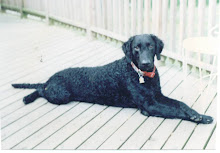
Hunter

Hunter
A true gentleman

Wednesday, April 1, 2009

Inspirational puppy "tail".

Chauncey and Linus,
A "Tail" of Friendship and Hope


This is the story of Chauncey, Windsong Tabor Drums On Water, John and Sue Woodliff’s eight month old Curly-Coated Retriever pup (born 06/27/2008) and Linus, the year and a half year old Heeler/Mutt mix that Chauncey has befriended.

On a warm sunny day in May, 2008, Linus was enjoying the sunshine while watching his owner, John’s son, Jeremy, doing yard work - of the gardening type. To keep him out of harm’s way, Jeremy had put Linus on a 30 foot line, staked in an area of the yard that was not being worked. Unfortunately, Sneaky Cat was teasing Linus while Jeremy worked. Linus took off after the streaking, Sneaky Cat, and when he hit the end of his 30' line, he flipped into the air and landed on his back, suffering severe spinal cord damage. Linus was about a year old at the time.

Although the choices were grim, John, Sue, & Jeremy opted to give Linus a chance and put him into some pricey new wheels, which gave him mobility, while allowing him to use his rear legs when possible. Linus can take a few steps but primarily uses his wheels to be mobile.

Enter "Wheels", as John affectionately calls him, into Chauncey’s story. Wheels recently came to stay with Chauncey when Jeremy had to relocate with his construction job on a temporary, yet long-term assignment.

So how does an eight month old Curly pup get along with a much smaller invalid? By making him forget that he is handicapped. Together the boys "run" and play on a daily basis. A favorite of both boys is a good game of "Stick".(photos enclosed) . The tug of war that ensues is usually won by Chauncey, but Linus doesn’t give up. Not even a blizzard can stop the games.

According to John, Chauncey plays and runs with Linus, letting him have the upper "leg" at times. They get along exceptionlly well, and Chauncey never leaves Linus behind. He actually watches out for him, letting him catch up, though Chauncey can run cirles around him. They eat, sleep, play, romp, and get into trouble together. Chauncey has given Linus companionship and encouragement to get up and get moving.

Jeremy thinks Chauncey is a very good companion for Linus, and having him around has given Linus more energy and someone to enjoy life with. We are encouraged that Linus has a better quality of life with his "wheels" and Chauncey to give him a reason to get up and get going. They do get along exceptionally well, and we hope their companionship to each other will make a difference in their lives for years to come.

A true story as told by John Woodliff and Iva H. Darnall, Originally Published in the April, 2009 Issue of The Curly Commentator, the official publication of the Curly-Coated Retriever Club of America (CCRCA)

Sunday, January 25, 2009

The perils of training blinds.

Training for blind work with Hunter, my Curly-Coated Retriever, was never ordinary. The theory is that you set up your training scenarios and run through them. Simple, right? Well, it was rarely simple for us. When I would set up blind drills, things usually happened.

On more than one occasion, as Hunter was swimming across the pond in the direction I had sent him, someone else's bumper that had been underwater, stuck in the mud, would just pop up in front of him. Naturally, he would think that I was sending him for the unexpected bumper so he would get it and return to me. I usually saw those and rarely tried to correct him for stopping early. We would then move on and set up something else to try to accomplish what I had originally intended to work on.

Often when we would train for land blinds, he would find someone's lost bumper in the grass, and again, he would retrieve that one and think his job was done. The problem with unexpected bumpers was that I didn't know they were there and couldn't see them right away, so often I confused him with more commands when he stopped prematurely. Since we were training blinds, I had to accept his find and let him think he did the right thing (which technically he did - he went out cold to a place he didn't choose to go and brought back his bumper).

The absolute worst training snafu, however, occurred on a pond we used to use all the time. I had sent Hunter toward the far bank on a line where he would have to swim past a point and push to the far side. As he neared the point, however, a Mama duck with her string of little ducklings swam across his path a few yards ahead of him and clearly, Mama duck knew he was there and was hurrying her crew as fast as she could. Hunter stayed on his line until it crossed the ducks' path then he took a hard left and began pursuit of the family.

I blew my whistle, I called him to come in, (I really didn't want him to traumatize a baby duck) but Hunter kept pursuing them, and he was gaining on them. None of my usual training commands were working. After all, I usually used those commands to put him on to ducks. And I'm sure in his mind, he knew that I meant for him to get that duck before he came in. It was right there.

As a last resort and with less than a yard to go before he caught up with the last straggling duckling, I pulled out one of my obedience commands and yelled "HUNTER, LEAVE IT!"

Like magic, he dropped his pursuit and swung around to face me, confused as to why I no longer wanted the ducks, but willing to obey the command. I yelled "Good Boy!" and "Hunter Come!" And to his credit, he headed toward me.

We had used that pond to train many times before and there had never been ducks there. Nor have there been ducks there since. Oh well, when you were out with Hunter, you learned to expect the unexpected.

Q & A for the day:

Why is it important to train for blinds?

A well trained retriever is a great conservation tool. He will retrieve each bird down and the hunter can take his limit.

Sometimes, when the dog is retrieving a downed bird, the hunter will shoot another one and the dog will have no idea where the second one fell. When the dog returns with his bird, the hunter will send him to the second bird. With training, the hunter can set the dog up, pointing him in the right direction and send him "back" toward the bird. Using a series of whistles and hand signals, the hunter can steer the dog to the spot of the fall. If the wind is in his favor, the dog's nose will guide him in, if not, the hunter can guide him to the fall.

The blind is first taught up close, then distance is added. You get quite a feeling of achievement when you and your dog communicate well enough to achieve the goal.

Thursday, January 1, 2009

A very good year, in reflection.

2008 was a very good year.

We ended the year with everyone we started with. Parents, kids, grandkids, brothers, sister, aunts, uncles, nieces, nephews, and dogs. All are healthy, happy and greeting 2009.

We also extended our family quite a bit. Yes, we added Taiko and his littermates and their new families. Taiko is a blast and the extended families are wonderful. They love their new curly kids and they send pictures. We also added Zoomy, a wonderful girl that is settling in nicely. Funny, I went from majority oldsters to majority youngsters in the household and things move much faster now.

Our summer was pretty much taken up with puppies but we did manage to squeeze in a few shows with old and new friends. Ziva was out of coat at every show we attended (and at one show after the pups she had NO curls) but we had fun and she garnered quite a few reserves, so we have hope for the new year if the coat will just coincide with show dates.

Destiny was able to attend every show with me and competed in Juniors at most. I never knew how much fun kids and dog shows could be. We'll be doing more of this in 2009.

We already have training plans for the new year. In January Taiko starts his second obedience class (he is just six months old and will be in formalized training for awhile-I am the one that needs the structure). He will also start obstacle familiarization in agility. Plus, he gets to do field work with the girls. Ziva will continue her obedience training and agility, as well as field work. (We have to take a hiatus from field work in the winter since our training partners are out hunting, duh). Zoomy will take novice obedience classes so that we can develop a mutual rapport. We haven't had time to figure out what she likes to do yet. I'm also hoping to enter someone in a tracking class that starts in the spring so that I can learn the mechanics of it. The old ones will continue to hold their places of honor and share the love.

In spite of all our big plans for the new year, we are most excited by the addition of a new human family member. Due in February, we're expecting a baby girl, call name Riley!

Happy New Year!

Sunday, October 19, 2008

Destiny and the Junior Dog Judging Contest

To my great delight, Destiny, my 12 year old granddaughter, was a last minute addition to my Louisville show trip. It was too late to enter her in any Junior Showmanship classes but she was able to participate in a junior handling clinic and a Junior Dog Judging Contest.

The announcement came over the loud speaker: Last call for all kids interested in signing up for the Junior Dog Judging Contest. Most of the Juniors pre-entered the contest when they sent in their Junior Showmanship entries and received their packets by mail. When Destiny signed up, she received a packet which contained four breed standards: the Boxer, the Border Collie, the Boston Terrier and the American Staffordshire Terrier. Destiny had never read a breed standard before (not even the Curly). She had exactly 30 minutes to prepare and learn all she could about the four, selected breeds.

It was an interesting competition. An AKC Judge did a show exam of the four or five dogs in each breed presented. His exam included a physical exam and bite, down and back, then around. The Judge ranked the dogs 1st through 4th but did not announce his placements. The Juniors were to try to place the dogs the way the Judge had.

The Juniors were allowed to spread out on two sides of the ring to watch the Judge’s examinations. When the Judge completed his placements, they were invited into the ring for a closer look at each dog while the entry was stacked in the center of the ring. They did not perform a physical examination or further movement exercises. The Juniors wrote their placements on a card and handed it to the Steward as they left the ring. This was repeated for three breeds, the Bostons showed up but didn’t wait around to be examined - they’d already had a long day.

After all breeds had been examined, the Judge conducted a personal interview with each Junior. The Juniors had to explain to the Judge why they put each dog in its particular placement order and what they liked/disliked about each one. During the interview phase, only one breed was discussed, the American Staffordshire Terrier. Some of the Juniors appeared nervous during the interview phase of the competition but Destiny was quite at ease and very animated in explaining what she liked about each dog and why she placed it in the order that she did.

Upon completion of the interviews, the scores were tallied and the Juniors were awarded placements from fourth through first. Out of the 20 or so Juniors who participated, Destiny was awarded second place. She had tied for first in her rankings of the dogs with the personal interview being used as the tie-breaker. Not bad at all for a kid who started "show doggin" 10 months ago.

I do believe she has "the eye" for it.

Originally Published in the June, 2008 Issue of The Curly Commentator, the official publication of the Curly-Coated Retriever Club of America (CCRCA)


Q & A for the day:

How does a youngster learn more about Junior Showmanship?

The American Kennel Club has a Juniors' section on their website at www.akc.org. There are links to the rules and lots of other resources for kids. Juniors are separated by their experience level and their age so that they compete against similarly situated kids.

You can even compete with your spayed or neutered purebred dog, and/or your previously unregistered purebred (with just a few steps to get it a PAL number - info also on the AKC website).

Junior Showmanship is a growing sport and it is fun for the kids that compete. New kids have started at almost every show we've been to. And, a kid that tries hard can compete with the seasoned competitors in no time.

Thursday, September 25, 2008

A Delightful Diversion

For the past several weeks we've been fully immersed in another endeavor. We've had puppies!! Six little curlies were born June 27. Watching them grow, morphing from little furballs into little doggies was so much fun. When they were tiny, I could sit by and watch them for hours. As they got bigger, it was more of the same.

Finding the perfect home for each pup was a challenge but worked out wonderfully in the end. Several of the pups will be hunting companions, a couple have children, another couple have grandkids and all will be family companions. It just doesn't get any better than that.

And the little guy that stayed with us . . . he is fabulous!!!

The photo journal of the pups is linked off of our home page but be forewarned, there are a lot of pictures (in case you are prone to puppy fever) and a few videos too.

Saturday, June 14, 2008

Needed - longer arms.

One of the perks of owning Curly-Coated Retrievers is the type of games you can play with them. Hunter, my first CCR introduced me to the fun of field training. I joined a great group of folks who had trained other retriever breeds for many years and they were very patient in teaching me the ropes. After awhile, I found the confidence to go out by myself to work on drills.

On one particular occasion, Hunter took extreme advantage of the pond in between us. I had sent him on a blind retrieve across the pond (several bumpers were already placed on the other side so he would see no bumper fall). When he got to the other side, however, he must have figured out that my arms weren't long enough to reach him so he could do as he pleased. And he did. He investigated every interesting smell he could find and peed on lots of things. He was having such a good time that he failed to notice that I was trotting around the pond.

He was so intent on investigating his latest find that until I said "Hunter, Heel!" from two feet away, he didn't even know I was there.

I know I've mentioned his "Oh S#!#!" look before, but this was the first time I ever saw it. He looked directly into my eyes and I could read his mind. He knew that he was in trouble and he instantly tried to fix it by snatching up his bumper and jumping into the pond, heading strait back to the spot where I had been standing on the opposite bank.

"Oh no you don't", I said and I called him to heel. To his credit he came out of the water, tail tucked between his legs and he slunk over to where I stood. He looked so pitiful standing there, dripping wet. He didn't even shake. He knew he was caught. A guilty conscience goes a long way with this dog. And before you wonder, "does he act that way because you beat him?" I can say absolutely not!! We train with praise! Besides, unless you can administer a correction simultaneously with the mis-deed, you may as well save it because the belated correction is totally useless as a teaching tool.

I was having a bit of difficulty not laughing at him so I decided to let him off the hook and put him back to work. I made him hold his bumper and sat him at the edge of the pond. Then I walked back around the pond to my original spot, faced him and from across the water I called, "Hunter Come!"

Now I had great visions of Hunter plunging into the water and swimming to me in a direct line, as he should have done to begin with. Instead, at my call, he took a sharp right turn and ran around the pond in the exact route that I had just taken.

Oh well, I was training blinds, not bank running so I held my tongue since he technically obeyed the command I had given him. After this episode, I decided that we needed to end the training session on a good note so I set him up again, held my breath and sent him "Back" across the pond for the last bumper. This time, he hit the water, swam across, picked up the bumper, turned and swam strait back to me.

Good dog!

Q & A for the day:

Hmmm, two good topics for this one so I'll pick the one folks have the most trouble recognizing - timing the praise or correction.

What do you mean, timing the praise or correction is everything?

I'll start with an example, you are teaching your dog to sit . . . he is right in front of you and you tell him to "sit" . . . and for the first time, his bottom hits the floor . . . you are sooooo excited that you throw your hands up in the air and clap . . . he experiences your delight and jumps up to celebrate with you . . . and you say "Good Dog".

You have just praised your dog for jumping up, not sitting. So the next time you want him to sit, he will remember how much praise he got when you said "sit" for jumping up and he will try to give you the jumping up behavior that he found most rewarding. He won't want to sit.

He's not a 'dumb dog' that can't learn to sit, he is a smart dog that learned what gets him praise and he repeats the action that got it for him. To reinforce the sit behavior, you must administer the praise while his bottom is still on the ground - it takes only seconds to miss the opportunity to praise correctly so you must be ready. If you miss it, say nothing, and try again.

It also helps to know that a dog's attention span for learning new activities can be counted in seconds, 5 - 10 seconds max, depending on age. So if you want to correct him for a misdeed, he must be doing the misdeed at the time of the correction. If you catch him chewing a chair leg, tell him "no chew" or "bad chew" and give him something appropriate to chew on, then follow up with a "good chew" - or whatever words you choose to use. Choice of word doesn't matter as long as you are consistent - it is the voice, not the word that counts - but command consistency helps during the learning process.

This is also why house training can take so long for some dogs. They don't associate a correction received well after the deed is done with actually doing the deed in the house. And shoving his nose in the pile doesn't help - he no longer associates an old pile with the 'doing of the deed'. That is why a crate is very useful in house training. The dog is contained in his den until you can escort him outside - then GO with him so that you can praise his doing the deed outside where you want it. Afterwards, keep a close eye on him and if he starts sniffing around the room, take him out again and if he performs praise him again. In house training, diligence is everything.

Be careful that you don't fall into the house training trap of training the dog to use the revolving door. If you let him out the door, he pees and comes back in, then gets a cookie, no matter what you are saying, in his mind he is being praised for coming inside - not peeing outside. That's why some dogs have to "go" so often - they are really going outside so that they can come right back inside and get a cookie :-). This is exactly why you need to go outside with the dog - so that you can give praise for the correct behavior - peeing, not coming in the door - the praise always comes outside. Lots of folks have spent lots of dollars going to the vet to make sure their dog doesn't have an infection because they always have to 'go'.

You will be amazed at the results you can get if you remember the proper use of these two words: "timing and praise".

Saturday, June 7, 2008

Million Dollar Babe

In the very, wee hours of the morning (4:30 a.m.), Singer, aka the Babe, my 11 y/o Curly-Coated Retriever, barked and woke me up. Thinking she had to go outside to make a nature call I (very grudgingly) rolled out of bed to let her out. It always irks me when she says one thing then does something else, but once I got up she obviously didn't want to go outside - still, since I was up, and the other girls were creating a ruckus now too, I let them all outside. As I walked back through the house, the doorbell rang, at a time when doorbells should not ring! I hate the adrenaline rush you get when doorbells ring at the wrong time.

I did an immediate about turn and let the girls back in, then went to a window that had a view of the door and there, bent over and peeping in the front door pane, was a shirtless man, that shouldn't have been there. I really hate the adrenaline rush you get when you see shirtless men that shouldn't be there.

My brain left my body at the sight of the man, but somehow I managed to think "shotgun" and I took great comfort in holding it while I dialed 911. The man was gone by the time the police came.

We'll never know what plans the prowler had, if any, but thanks to the Babe, we're safe. Now the other girls were probably helping too, but since Singer barked first and woke me up, she gets the credit. Deacon was in another part of the house so he didn't get to help. He is my second line of defense if anyone gets past the girls.

The Babe - a million dollars. . . sleeping through the night under her watchful eye/ear, priceless.