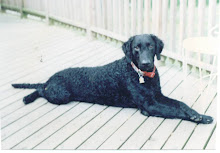
The first time ever I saw her climb . . . (ok, I went lyrical because her name is Singer).
We had traveled to Flora, Mississippi (near Jackson) to run an AKC hunt test conducted by the Magnolia Hunting Retriever Club. Singer, my Curly-coated Retriever, was 9 1/2 months old and needed to pass the test to earn her AKC Junior Hunter (JH) title.
For those who don't know, at the Junior level, two judges and the dog and handler stand at the line, a bird goes down and the dog is sent to pick it up immediately. The dog must pick up two individual retrieves on land and two on water and they are graded in several areas in order to pass the test. They must pass four tests to earn the JH title.
No water test is ever "easy" when you are the one standing at the line, but this one was stacked against the Babe. First, as she swam through the "flock" of decoys, she got tangled in one decoy's line and dragged it across the pond, continuing towards her bird as though the decoy wasn't even there. She shook the decoy at the bank, picked up her bird and retraced her path, strait back to me through the water.
Then, on the second mark, the bird was supposed to be thrown in the water just behind a fallen tree that was designed to be an obstacle in the direct line between the dog and the fall. The bird was thrown, and Singer began her swim towards the fall, and by necessity, the tree.
When she reached the tree, however, instead of swimming around it as the other dogs had done, she swam directly into it (there was no easy path through it). Then, she started trying to climb it . . . she would hook her front legs over a limb, move them up to a higher limb, pull her back legs onto the first limb . . . and sink back into the water, as the lower limbs had no resistance in the water to help hold her weight. This was repeated several times, but she wouldn't give up. She kept trying to get high enough to break free of the water.
Back on the line, the judges and I kept trying to figure out what she was doing. We thought she'd gone nutz! And I was trying to decide whether it was time to call her in (knowing she wouldn't come back without a bird). I didn't want to go swimming to get her and the judges never said "pick up your dog" so I waited. And she just kept trying to climb that tree.
After what seemed like an eternity (time stands still on the line), but more like one or two minutes, she broke water and literally climbed about four feet into the tree. She came down with her duck! Unbeknownst to anyone, the bird had accidently been thrown into the crown of the fallen tree - we had all watched it go down but assumed it had fallen into the water behind the tree. My little girl watched it go down too, and she followed the mark and her nose . . . into the tree, and she didn't give up until she got her bird.
Afterwards, I accused the judges of trying to sabotage her tests because she was curly. They laughed, but they were amazed by her performance.
Over time, Singer has climed into a few more bushes and trees looking for things real or imagined. And I smile every time I pass those bright orange ribbons that remind me of the tense moments as I watched the nutty little Curly try to climb a tree.
Q & A for the day:
How can I get my retriever involved in training and running a hunt test?
I'll say this first - you are looking at spending hours training, gas traveling and cash for the accessories. You may make friends with folks who do the same thing. And, if you get hooked, you'll be doing it a lot more. You might even find yourself trading in your car for a vehicle that can carry your dog and your "stuff" - I moved up after a few years. I managed quite well using two folding General crates and a sun shield, operating from the trunk of my Thunderbird (and there weren't that many places that I couldn't get to in the car).
Hunters use training for hunt tests to keep their dogs conditioned during the off season. Others participate for the pleasure of the sport. So there are usually people out training in many areas for a number of reasons.
Sometimes, you can see folks out training and you can walk up, introduce yourself and express your interest in getting started. (In the summer, look for them at dawn when the day is still cool - they're usually done by mid-morning.) They may or may not be helpful, but you can usually get the name of someone to contact who will be helpful. Don't confuse 'hot and tired' with indifference, although you may see either, but you can still get that name.
You can also ask your other dog associates - e.g. someone at the obedience, agility or conformation club will know who trains their retrievers. Or, you might check at the sporting goods store that carries dog training equipment. You may find them at work or at church, you just have to ask (or check the parking lot for vehicles with dog crates and DU decals). You get the picture.
In today's information age, clubs are pretty easy to find. When you contact a local club, you can usually find out who is training in your area. Many clubs actively mentor newcomers and will put you in touch with someone who can help you get started.
The Amercan Kennel Club lists their test-giving clubs on their website at http://www.akc.org/clubs/search/index.cfm?action=perf&display=on,
just select "hunting tests" and your state. A contact for each club is listed. If you have to write, send your email address and a phone number to make it easier for them to contact you.
The United Kennel Club (UKC) lists their clubs as well at http://www.ukcdogs.com/Clubs.nsf/ClubViewHRC?Open&Start=1&Count=30&Type=HRC&List=A
In my opinion, the UKC tests are the most fun and realistic (patterned after actual hunting scenarios and emphasizing gun safety) to run.
The North American Hunting Retriever Association lists member clubs at http://www.nahranews.com/html/nahra/clublist.htm These folks are not everywhere but I've heard good things about their tests.
There are also pro-trainers out there (both good and bad - interview them like you would a nanny for your child) but I don't recommend going that route, at least until you determine that you like the sport enough to become involved in it. All of my dogs have been owner trained and handled. I love the sport and have nothing to prove that would require the use of a pro trainer.
Hunter

A true gentleman
Sunday, May 18, 2008

Thursday, May 8, 2008
A soft mouth
Deacon, my Curly-Coated Retriever, has a very soft mouth. Since he was not actively field training, I might have missed this fact except for an incident that happened one spring morning.
Every morning the dogs run outside in a fenced back yard then come in and hang out with me for awhile before I have to go to work. One morning, after the dogs had been back inside for about half an hour I noticed that unmistakable look on Deacon's face and knew that he was hiding something in his mouth. You know the look, the cheeks kind of puff out and it's the only time that he isn't under foot.
Fearing the worst, I stuck out my hand and said "Give!". He hesitated for a few moments then moved to give me his prize. Very gently, he placed an object in my hand. . . a bird. . . a baby bird . . . a tiny, featherless baby bird. . . that was now opening and closing its mouth waiting for "mama" to provide the next meal. The baby bird had been comfortably hiding in his mouth for half an hour.
I didn't have the heart to tell Mama Deacon that his baby would not survive. . . it was too young to survive without a real mother bird. We went out and looked for a nest but there was none to be found. We left the baby where its mother could find it if she was looking for it and went back inside.
Also see: Soft Mouth; Can You Train It posted on this blog on 01/17/2010.
Q & A for the Day:
So, what is a soft mouth in retriever lingo?
The dog must have a firm grip to hold a bird, from a small dove to a large goose. The soft mouth is best evidenced by what the dog delivers to you. . . a bird without teeth marks or crush injuries (from the dog's jaw). A soft mouth is evidenced by a firm hold with no chewing or chomping. The bird has usually been shot so there will be blood, but the retriever should not be enticed by the blood to determine that the bird should become his own dinner (yes, it happens). There is some confusion with this point, though, because a soft mouthed dog can also decide to eat the bird, but that is usually a training issue.
A well trained retriever is a great conservation tool. Hunters who take their daily limit without a good retriever (human or canine :-) have probably left several dead birds at the hunt site because they couldn't reach or find them. A good hunting dog will retrieve every bird that falls so there are no unnecessary kills required to meet the limit.
For those hunters that "kill" more than the legal limit so they can leave with a limit. . . shame on them. Every bird down counts. If they want to take them all home, they should get a good 'huntin dawg'.
Every morning the dogs run outside in a fenced back yard then come in and hang out with me for awhile before I have to go to work. One morning, after the dogs had been back inside for about half an hour I noticed that unmistakable look on Deacon's face and knew that he was hiding something in his mouth. You know the look, the cheeks kind of puff out and it's the only time that he isn't under foot.
Fearing the worst, I stuck out my hand and said "Give!". He hesitated for a few moments then moved to give me his prize. Very gently, he placed an object in my hand. . . a bird. . . a baby bird . . . a tiny, featherless baby bird. . . that was now opening and closing its mouth waiting for "mama" to provide the next meal. The baby bird had been comfortably hiding in his mouth for half an hour.
I didn't have the heart to tell Mama Deacon that his baby would not survive. . . it was too young to survive without a real mother bird. We went out and looked for a nest but there was none to be found. We left the baby where its mother could find it if she was looking for it and went back inside.
Also see: Soft Mouth; Can You Train It posted on this blog on 01/17/2010.
Q & A for the Day:
So, what is a soft mouth in retriever lingo?
The dog must have a firm grip to hold a bird, from a small dove to a large goose. The soft mouth is best evidenced by what the dog delivers to you. . . a bird without teeth marks or crush injuries (from the dog's jaw). A soft mouth is evidenced by a firm hold with no chewing or chomping. The bird has usually been shot so there will be blood, but the retriever should not be enticed by the blood to determine that the bird should become his own dinner (yes, it happens). There is some confusion with this point, though, because a soft mouthed dog can also decide to eat the bird, but that is usually a training issue.
A well trained retriever is a great conservation tool. Hunters who take their daily limit without a good retriever (human or canine :-) have probably left several dead birds at the hunt site because they couldn't reach or find them. A good hunting dog will retrieve every bird that falls so there are no unnecessary kills required to meet the limit.
For those hunters that "kill" more than the legal limit so they can leave with a limit. . . shame on them. Every bird down counts. If they want to take them all home, they should get a good 'huntin dawg'.
Saturday, March 8, 2008
First Day on the Job
I still shudder when I remember my first day on the job. I'd hurried home from class and let my two Curly-Coated Retrievers and my pound puppy of the Husky persuasion out the back door. We had a lovely little privacy fenced yard where they could run and play. In the meantime, I put on my best suit, and psyched myself up for my new job.
Just as I was putting on the finishing touches I heard an "explosion" of dog out back which sounded like they were killing each other. I ran out on the deck looking for the dogs - they were, they were . . . where were they?
Finally, I spotted the back half of young Deacon, sticking out of the dog house and wagging like crazy. This was really strange as the dog house was left over from a prior tenant and probably housed a Chihuahua. The door was only 12 inches tall. Still no sign of the other two.
I crossed the yard and grabbed Deacon and backed him out of the dog house. Ah, there are the other two, in the dog house. This was even stranger as the dog house was tiny, and the 120 pounds of dog still in there were packed in like Sardines.
As the best strategy I could muster was 'divide and conquer' I took young Deacon and tossed him in the kitchen, then went back for Hunter. I ordered Hunter out of the dog house. He came, but was ready to dart back in so I took his collar and led him away, then locked him on the deck.
Finally, I went back for Niki. He kept his tail towards me and wouldn't turn around so I got down on my knees, stuck both hands in the dog house (that's all of me that would fit through the tiny opening), grabbed a hold and pulled. Strangely, he didn't fight to stay in the doghouse and he slid right out . . . with the source of the problem. He had a choke hold on a racoon. A now, asphyxiated racoon. It took a great deal of effort to convince Niki to give up his prize. And the instant his grip loosened, I put distance between the two and took him inside.
After securing the dogs I decided to leave the racoon where he lay. I wasn't a hundred percent sure he was dead and I didn't want to risk being attacked. Plus I had used up all of the spare time I had allowed myself before I had to leave for work.
I was hot, sweaty, and dirty. The best I could do was knock off the dirt, wash my face, put on a forced smile and go. Luckily, my first day on the new job was totally uneventful compared to the excitement that led up to it. And if anyone thought I looked a mess, they kindly didn't say so to my face.
The racoon did, in fact, meet his maker that day. The best I can figure is that he was surprised by the dogs and tried to escape by running into the dog house - not a very good plan. Nobody was bitten or scratched and the racoon didn't have a mark on him. The vet assured me that everyone was current on their shots so they were safe. The dog house was removed a couple of days later. And after awhile, I calmed down too.
Q & A for the day:
How can you make your dog leave wild critters alone?
Acutally this is a trick question. Always remember, a dog is what he is, a dog. If there is a critter that invokes the dog's prey drive, the dog will most likely give chase. A high degree of training may allow you to call your dog off, but that will not prevent him from going after wildlife if left unattened. The best way to make your dog leave critters alone is to deter them from coming into his space. Remove food, water and hiding places and make the area inhospitable for wild life. But note, when the dog is in the area, water must be available for him, just take it up when he comes inside. There will be some instances where you can't remove those things that attract wildlife (a pond comes to mind) and you may always have critters. In that case, just be sure to maintain the dog's protective immunities (vaccines) to those ills most likely to affect him.
Just as I was putting on the finishing touches I heard an "explosion" of dog out back which sounded like they were killing each other. I ran out on the deck looking for the dogs - they were, they were . . . where were they?
Finally, I spotted the back half of young Deacon, sticking out of the dog house and wagging like crazy. This was really strange as the dog house was left over from a prior tenant and probably housed a Chihuahua. The door was only 12 inches tall. Still no sign of the other two.
I crossed the yard and grabbed Deacon and backed him out of the dog house. Ah, there are the other two, in the dog house. This was even stranger as the dog house was tiny, and the 120 pounds of dog still in there were packed in like Sardines.
As the best strategy I could muster was 'divide and conquer' I took young Deacon and tossed him in the kitchen, then went back for Hunter. I ordered Hunter out of the dog house. He came, but was ready to dart back in so I took his collar and led him away, then locked him on the deck.
Finally, I went back for Niki. He kept his tail towards me and wouldn't turn around so I got down on my knees, stuck both hands in the dog house (that's all of me that would fit through the tiny opening), grabbed a hold and pulled. Strangely, he didn't fight to stay in the doghouse and he slid right out . . . with the source of the problem. He had a choke hold on a racoon. A now, asphyxiated racoon. It took a great deal of effort to convince Niki to give up his prize. And the instant his grip loosened, I put distance between the two and took him inside.
After securing the dogs I decided to leave the racoon where he lay. I wasn't a hundred percent sure he was dead and I didn't want to risk being attacked. Plus I had used up all of the spare time I had allowed myself before I had to leave for work.
I was hot, sweaty, and dirty. The best I could do was knock off the dirt, wash my face, put on a forced smile and go. Luckily, my first day on the new job was totally uneventful compared to the excitement that led up to it. And if anyone thought I looked a mess, they kindly didn't say so to my face.
The racoon did, in fact, meet his maker that day. The best I can figure is that he was surprised by the dogs and tried to escape by running into the dog house - not a very good plan. Nobody was bitten or scratched and the racoon didn't have a mark on him. The vet assured me that everyone was current on their shots so they were safe. The dog house was removed a couple of days later. And after awhile, I calmed down too.
Q & A for the day:
How can you make your dog leave wild critters alone?
Acutally this is a trick question. Always remember, a dog is what he is, a dog. If there is a critter that invokes the dog's prey drive, the dog will most likely give chase. A high degree of training may allow you to call your dog off, but that will not prevent him from going after wildlife if left unattened. The best way to make your dog leave critters alone is to deter them from coming into his space. Remove food, water and hiding places and make the area inhospitable for wild life. But note, when the dog is in the area, water must be available for him, just take it up when he comes inside. There will be some instances where you can't remove those things that attract wildlife (a pond comes to mind) and you may always have critters. In that case, just be sure to maintain the dog's protective immunities (vaccines) to those ills most likely to affect him.
Wednesday, February 20, 2008
A mud puppy
I know I don't hold the monopoly for owning the 'best puppy in the world' but Singer, my curly-coated retriever, was pretty close, if you ask me. She could sit quietly in my lap for long periods of time (through a business meeting) and visit with the person sitting next to me - of course, she ended up visiting herself around the room from lap to lap and had to be collected after the meeting.
She loved field training. At 3 months of age she discovered the joys of "duck" and never looked back. She was such an avid retriever that she took one of my older dog's places when we went training (is there really an unwritten rule that when training with a group you're limited to two dogs?)
She really was a sweetie, but she did have one terrible flaw. She loved mud! This flaw first surfaced when she was a tiny pup. While walking in the park one day, she spied a mud puddle. Being on a leash, she couldn't get to it so she "ordered" me to get close. I wasn't sure what she wanted but followed her pull, snapping her back just in the nick of time when I realized she wanted to do a belly splat into it.
If you've never seen a puppy throw an all out temper tantrum, you missed it. It was so funny. We laughed at her while she wiggled, squirmed and screamed trying to reach that puddle. She pulled to the end of her leash and tried throwing herself at it. Had she been older and bigger that might have worked. The only way to distract her was to put distance between her and the puddle so we moved to dryer ground. She's never really gone for mud as an adult, thank goodness, though she has retrieved birds in some pretty scuzzy water without complaint.
Q & A for the day:
Is there really any harm in giving in to your dog?
Yes! Giving in implys that you made the concession and the dog got what it wanted. The only consistent thing about successful dog training is Consistency. If the dog ever learns that he can wait you out, you have created a larger problem. If you give a command, you must get the action requested - no exceptions. The number one booboo is calling the dog to come to you when you have no way to make sure he comes. If you are going to teach commands, you must have sufficient control of the dog to make sure he obeys the commands you give. A long leash is the best tool for teaching Come. The Golden Rule (or one of them) is "Never give a command you can't enforce".
She loved field training. At 3 months of age she discovered the joys of "duck" and never looked back. She was such an avid retriever that she took one of my older dog's places when we went training (is there really an unwritten rule that when training with a group you're limited to two dogs?)
She really was a sweetie, but she did have one terrible flaw. She loved mud! This flaw first surfaced when she was a tiny pup. While walking in the park one day, she spied a mud puddle. Being on a leash, she couldn't get to it so she "ordered" me to get close. I wasn't sure what she wanted but followed her pull, snapping her back just in the nick of time when I realized she wanted to do a belly splat into it.
If you've never seen a puppy throw an all out temper tantrum, you missed it. It was so funny. We laughed at her while she wiggled, squirmed and screamed trying to reach that puddle. She pulled to the end of her leash and tried throwing herself at it. Had she been older and bigger that might have worked. The only way to distract her was to put distance between her and the puddle so we moved to dryer ground. She's never really gone for mud as an adult, thank goodness, though she has retrieved birds in some pretty scuzzy water without complaint.
Q & A for the day:
Is there really any harm in giving in to your dog?
Yes! Giving in implys that you made the concession and the dog got what it wanted. The only consistent thing about successful dog training is Consistency. If the dog ever learns that he can wait you out, you have created a larger problem. If you give a command, you must get the action requested - no exceptions. The number one booboo is calling the dog to come to you when you have no way to make sure he comes. If you are going to teach commands, you must have sufficient control of the dog to make sure he obeys the commands you give. A long leash is the best tool for teaching Come. The Golden Rule (or one of them) is "Never give a command you can't enforce".
Sunday, February 10, 2008
Tackling Toenails
When Hunter, the 3 year old Curly-Coated Retrievier, joined the Windsong family, he came with monster toenails. Not only were they way too long, they were also too big for the clipper that I used on Niki, the Huskyish pound puppy, and they were jet black so I couldn't see through them. In retrospect, it is probably good that the clipper was too small as I could only nip off less than 1/8 inch at the tip of the nail. Hunter let me do one, count it, ONE toenail, before he screamed and jumped and ran away. I was stupefied, but that didn't matter at the moment because I was so busy running around behind him wiping up the blood spots from where that one toenail bled (I later learned about the wonderful stuff that can stop bleeding). The quik had grown to the end of the toenail.
After much study on alternative methods to do toenails, I settled on a cordless, dremmel drill to takle the job. Now, how was I going to make him let me touch those toenails? It wasn't going to happen, according to Hunter so I had to figure out a way to make him trust me again.
And then I hit on his weak spot, his belly. Hunter would lay beside me on the floor and let me rub his belly forever, nudging my hand every time I stopped. It dawned on me one evening that while rubbing his belly, I could turn the dremmel on and let him get used to the sound. He learned fast, that if he laid still, I would keep rubbing his belly so the noise became a tolerable nuisance. Next I adjusted our shared space so that I could reach his belly and all the toenails without moving. Then I started messing with his feet while I rubbed his belly, and then touching a toenail with the dremmel. It is amazing how much annoyance he was willing to accept as a trade off for his belly rub.
To make a long story short, we tackled those monster toenails. Now, all my Curlies get early toenail training with belly therapy and the dremmel drill. It is a process, but when complete, they tolerate getting their nails done. When I announce "toenail time", they all willingly join me in the living room and wait for their turn to get their toenails done. They come to me, I never have to get up (I sit on the floor to do toenails) and hunt them down or drag them to the dremmel. They come, lay down and roll over, belly up and wait for me to get started. Deacon is notorious for trying to go twice and Ziva is learning that trick too. It's almost funny having to shove off one Curly while another one claims the magic spot that belly rubs come from. Notice, I said almost - there's nothing like being squished between two big dogs who both want to be in your space.
When I hear other Curly-Coated Retriever owners talk about their toenail woes, I offer up my belly advice (I wrote an article for the Curly-Commentator about it once). I'm also told by some owners that cookies work for them. If you want to look up the psychological terms for this trade-off behavior, feel free. I'm just happy that it works and that we have a great experience at toenail time. It seems that everything good in life begins and ends with a belly rub.
Q & A for the day:
While we're on the topic of toenails, and assuming you end up with the belly side of the dog at your disposal, What are some other things you can do during the toenail process?
I have a toenail kit that contains first aid stuff, medicated powder, triple antibiotic cream, scissors and a few other handy items. The scissors afford me the opportunity to do some underside grooming, if necessary. I use toenail time to examine the entire underside of the dog. I find any bumps, lumps, scratches, rashes or other problems at this time. Since some dogs only give me one shot at doing their nails, it is essential that the kit be in reach so that I can address whatever I find without getting up. And they don't mind the exam if it is camoflauged as a belly rub.
After much study on alternative methods to do toenails, I settled on a cordless, dremmel drill to takle the job. Now, how was I going to make him let me touch those toenails? It wasn't going to happen, according to Hunter so I had to figure out a way to make him trust me again.
And then I hit on his weak spot, his belly. Hunter would lay beside me on the floor and let me rub his belly forever, nudging my hand every time I stopped. It dawned on me one evening that while rubbing his belly, I could turn the dremmel on and let him get used to the sound. He learned fast, that if he laid still, I would keep rubbing his belly so the noise became a tolerable nuisance. Next I adjusted our shared space so that I could reach his belly and all the toenails without moving. Then I started messing with his feet while I rubbed his belly, and then touching a toenail with the dremmel. It is amazing how much annoyance he was willing to accept as a trade off for his belly rub.
To make a long story short, we tackled those monster toenails. Now, all my Curlies get early toenail training with belly therapy and the dremmel drill. It is a process, but when complete, they tolerate getting their nails done. When I announce "toenail time", they all willingly join me in the living room and wait for their turn to get their toenails done. They come to me, I never have to get up (I sit on the floor to do toenails) and hunt them down or drag them to the dremmel. They come, lay down and roll over, belly up and wait for me to get started. Deacon is notorious for trying to go twice and Ziva is learning that trick too. It's almost funny having to shove off one Curly while another one claims the magic spot that belly rubs come from. Notice, I said almost - there's nothing like being squished between two big dogs who both want to be in your space.
When I hear other Curly-Coated Retriever owners talk about their toenail woes, I offer up my belly advice (I wrote an article for the Curly-Commentator about it once). I'm also told by some owners that cookies work for them. If you want to look up the psychological terms for this trade-off behavior, feel free. I'm just happy that it works and that we have a great experience at toenail time. It seems that everything good in life begins and ends with a belly rub.
Q & A for the day:
While we're on the topic of toenails, and assuming you end up with the belly side of the dog at your disposal, What are some other things you can do during the toenail process?
I have a toenail kit that contains first aid stuff, medicated powder, triple antibiotic cream, scissors and a few other handy items. The scissors afford me the opportunity to do some underside grooming, if necessary. I use toenail time to examine the entire underside of the dog. I find any bumps, lumps, scratches, rashes or other problems at this time. Since some dogs only give me one shot at doing their nails, it is essential that the kit be in reach so that I can address whatever I find without getting up. And they don't mind the exam if it is camoflauged as a belly rub.
Wednesday, February 6, 2008
Hunting Retrievers
Although the Windsong Curlies are city dogs, they enjoy a relatively private back yard where interesting critters abound to retrieve . I've gradually learned to accept the occasional gift of an unlucky squirrel or bird which wasn't fast enough to escape from whichever Curly-Coated Retriever was hunting in the back yard.
I'm rarely able to intervene, but once I was successful.
Hunter was prowling for prey when I saw him dash towards the back of the yard. He caught a Chipmonk that tried to escape from him by climbing the fence (dumb move). I yelled at him to "drop it" and he did, for all of two seconds.
Then he snatched it up again, so I started walking towards him and ordered him to "leave it", which he did, for two more seconds.
Then he snatched it up, yet again. You have to appreciate that the critter kept trying to escape each time it was spit out, so the "chase" kicked his prey drive into gear and Hunter would grab it again.
Hunter was so absorbed with his prey that he failed to notice how close I had come.
"HUNTER!!" I yelled. He looked up, strait into my eyes, and I could literally see him thinking, "Oh S#!#!" He spit the Chipmonk out and ran for his life!
The poor thing wasn't dead - I could see its heart beating ninety to nothing through its chest. I picked it up by a rear foot and carried it to safety. It laid there for five minutes before it dove under a leaf pile, never to be seen by us again.
Hunter always had a soft mouth. The Chipmonk didn't have a scratch on him (slobber yes, but no gashes or crush wounds). Afterwards it was funny, but in the moment, I worried about all the unhealthy things that wild Chipmonks might carry.
Q & A for the day:
What should you do when your dog catches wild creatures? First, don't ever try to take a "live" anything out of his mouth, you might get bitten (by either of them) or scratched. Chances are if he doesn't let it go, or chew or crush it to death, he'll get tired of it after awhile and lay it down. If it is already dead, you can tell him to give it to you. When he gives you the prey, a newspaper bag or grocery bag makes a quick glove and disposal unit in one.
"Give" (or any word you use for that action) is a trained action. The best time to teach your dog to "give" you things is well before he catches wild game - using toys and other objects - rewarding him with treats or his favorite toy when he performs correctly.
If your dog was bitten or scratched, you should call your vet to be sure, but if he is up on his vaccinations, including rabies, he should be OK. Treat any scratches with anti-bacterial salve but check with your vet for the best treatment for puncture wounds.
I'm rarely able to intervene, but once I was successful.
Hunter was prowling for prey when I saw him dash towards the back of the yard. He caught a Chipmonk that tried to escape from him by climbing the fence (dumb move). I yelled at him to "drop it" and he did, for all of two seconds.
Then he snatched it up again, so I started walking towards him and ordered him to "leave it", which he did, for two more seconds.
Then he snatched it up, yet again. You have to appreciate that the critter kept trying to escape each time it was spit out, so the "chase" kicked his prey drive into gear and Hunter would grab it again.
Hunter was so absorbed with his prey that he failed to notice how close I had come.
"HUNTER!!" I yelled. He looked up, strait into my eyes, and I could literally see him thinking, "Oh S#!#!" He spit the Chipmonk out and ran for his life!
The poor thing wasn't dead - I could see its heart beating ninety to nothing through its chest. I picked it up by a rear foot and carried it to safety. It laid there for five minutes before it dove under a leaf pile, never to be seen by us again.
Hunter always had a soft mouth. The Chipmonk didn't have a scratch on him (slobber yes, but no gashes or crush wounds). Afterwards it was funny, but in the moment, I worried about all the unhealthy things that wild Chipmonks might carry.
Q & A for the day:
What should you do when your dog catches wild creatures? First, don't ever try to take a "live" anything out of his mouth, you might get bitten (by either of them) or scratched. Chances are if he doesn't let it go, or chew or crush it to death, he'll get tired of it after awhile and lay it down. If it is already dead, you can tell him to give it to you. When he gives you the prey, a newspaper bag or grocery bag makes a quick glove and disposal unit in one.
"Give" (or any word you use for that action) is a trained action. The best time to teach your dog to "give" you things is well before he catches wild game - using toys and other objects - rewarding him with treats or his favorite toy when he performs correctly.
If your dog was bitten or scratched, you should call your vet to be sure, but if he is up on his vaccinations, including rabies, he should be OK. Treat any scratches with anti-bacterial salve but check with your vet for the best treatment for puncture wounds.
Tuesday, February 5, 2008
Curlies in the basement
With wild weather storming around us, civil defense sirens blaring and little time to worry whether we'd be better off upstairs or down, I decided we'd all go to the basement.
What fun? I could only get two dogs down the steps at any one time. Then when I got the other two heading down, the first two would run out. Yes, we're going to practice that in the daylight.
Eventually everyone made it down to the basement. I need more toys down there. And maybe a storm kit with chewies and other things. I'll do that in the daylight too.
Luckily, everything passed us by. The curlies enjoyed our time in the basement but were glad when we went back upstairs for a late supper.
Today's timely Q & A:
Since we spent time in the basement tonight, what did I learn that I should have had down there in case of emergency? The weather casters said stick some i.d. in your pocket so I did that and grabbed my weather radio/flashlight. But I should have had some extra leashes down there too . . . and some toys and chewies to keep them happy and busy . . . a first aid kit and a jug of water with a bowl to pour it in. I'm sure I'll think of other things too, but that is a good start.
What fun? I could only get two dogs down the steps at any one time. Then when I got the other two heading down, the first two would run out. Yes, we're going to practice that in the daylight.
Eventually everyone made it down to the basement. I need more toys down there. And maybe a storm kit with chewies and other things. I'll do that in the daylight too.
Luckily, everything passed us by. The curlies enjoyed our time in the basement but were glad when we went back upstairs for a late supper.
Today's timely Q & A:
Since we spent time in the basement tonight, what did I learn that I should have had down there in case of emergency? The weather casters said stick some i.d. in your pocket so I did that and grabbed my weather radio/flashlight. But I should have had some extra leashes down there too . . . and some toys and chewies to keep them happy and busy . . . a first aid kit and a jug of water with a bowl to pour it in. I'm sure I'll think of other things too, but that is a good start.
Subscribe to:
Posts (Atom)