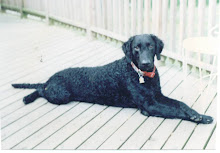
One evening, as my brother, Pete, and I stood under my carport looking at my Curly-Coated Retrievers playing in the back yard, I noticed that my wicked little puppy had turned the water bowl over, again, and had played with the empty plastic bucket until it was way back in the yard. Pete teased me about having to go out back to get the bucket to water the dogs - like it would be a big chore. But I laughed and told him there was no need, I could send Hunter for the bucket and let him water them from where I stood. Pete was sure that it couldn't be done and said as much so I decided to give it a try.
Sending Hunter for the bucket was fairly easy. He already took back casts and once I got him to the area and told him to fetch it up, there was only one object available to retrieve. A quick "good boy" as soon as he nosed the bucket told him that it was what I wanted and he picked it up and brought it to me.
Now the floor of the carport is several feet above the back yard with a wrought iron railing that makes up the top of the "fence" so Hunter had to prop up on the concrete wall as I leaned over the railing to take the bucket.
The next step was the tricky part. After I filled the bucket from the hose out front, I took it back and called Hunter. He hopped up again and I placed the handle near his mouth and said "take it". I had never taught him to deal with a bucket, especially one filled with water, but he obediently took the handle and hopped down again.
Unfortunately, none of his regular commands, 'drop' or 'leave it', meant anything when applied to releasing the bucket so he just stood there and held it. Things got funny when the other dogs realized that Hunter's bucket had water in it. They started trying to drink as he moved away to protect his bucket. They followed him and the whole thing ended up with a hilarious game of chase. . . Hunter running with his bucket, the other dogs following, trying to snatch a drink on the run. And Pete and I were laughing hysterically as they ran around the yard.
In the end, the bucket got knocked down, but Hunter was able to get a drink too.
And all I could say was "I told you my dog could do that".
Hunter

A true gentleman
Saturday, February 20, 2010

Sunday, January 17, 2010
Soft Mouth; Can you train it?
"How do you train a soft mouth?" is the number one question that I hear from dog owners, especially from retriever owners. This is often rephrased in the question "How do you prevent a hard mouth?" Some folks believe that a dog is either born with a soft mouth, or not. Based upon what I've seen in the whelping box, I just don't agree with that as a blanket statement.
Starting as pups, dogs learn to communicate using their mouths. The Mama dog "speaks" to her pups by licking them, nuzzling them, and occasionally, when they ask for a correction, by nipping them. It is a natural part of rearing her pups.
When watching pups in a litter grow, they all mouth and bite each other as a part of learning communication skills, and more importantly, good manners. If you observe the litter, planning to pick the puppy with the "soft mouth", you'll probably be frustrated because all the pups mouth and nip in play.
From a retriever perspective, there isn't a separate protocol for training a soft mouth. You'll deal with that as a function of teaching your pup to 'take' an object, 'hold' the object properly and 'give' it to you on command. If your pup doesn't have solid performance in all three of these actions, DO NOT continue. This (moving on too soon) is where the dog learns that he has your permission to chomp it or keep it. Get your solid foundation before you try to build on it. And don't worry if everyone else keeps going, they are working with different dogs. The only dog you need to worry about is the one you are training. There is no room for 'one-upmanship' while training your dog.
The Golden Rule for training a soft mouth is "Start it, stick with it, and be consistent". Well actually, that is the Golden Rule for all training.
It would be a disservice for me to try to tell you in a paragraph "how to" teach your dog what most authors devote an entire chapter to. So, I recommend reading a few good texts before you start training. Read books that help you understand dog behavior (for novices, Mother Knows Best and Know Your Dog , among others, are in my lending library), then read about training in the venue you want to learn. As you tackle each step, go back and re-read the relevant chapter. You'll be surprised how much more it says than it did the first time you read it. If you read enough, you'll see very different philosophies emerge. You'll need to develop your own philosophy and stick with it to avoid confusing your dog.
Ultimately, results with your first dog will be your best teacher. If you have no experience training a dog, I highly recommend enrolling in an obedience class - you'll learn 'your' dog, which is the only dog you'll be training. Don't worry if it doesn't focus on the venue you want to train. The most important function of the class is to teach you what a dog is from the dog's perspective. Building your dog/handler team is the second most important function of the class. Teamwork spreads over all you and your dog do and makes each venue better. Read all you can, talk to many people as you can, work through obedience classes at least twice - once to learn and again to fine tune with lots of distractions - and train, remembering that several short sessions are better than one long session when teaching a pup new things.
And here's a few other things that people forget to tell you. 1. If you have a bad attitude today, don't train today. It will affect your long term results. 2. Positive reinforcement is best, especially for teaching new things. 3. Your dog wants to please you. 4. You will be very good at confusing your dog. 5. Several 10 minute sessions are better than one long session for teaching something new. 6. And to quote a world renowned, professional retriever trainer: "Even bad trainers can get good results if they stick with it long enough".
Ultimately, remember that you are the Alpha in your pack and it is your job to take care of your dog. Never let yourself be coerced into any training tactic that goes against your comfort level. You must learn how to filter through information. Take all you are given, then use what you need. Don't worry about saying "No". I've heard too many folks lament "ruining" their dogs with bad advice. I recall following bad advice once when I could tell instantly that I shouldn't have. The results were long term and I spent hours trying to undo the damage because I didn't think it through first. Now I have no trouble saying "No" when necessary. I'm sure I've done plenty more things wrong, but those had more subtle results.
For Deacon's 'soft mouth' tale, see "A Soft Mouth" on this blog dated May 8, 2008.
Q & A for the day
Is there a good reason for pups to stay in the litter longer?
YES, My pups never leave before they are 8 weeks old and I prefer to keep them a week or two longer. The pups learn most of their good manners from their mom and littermates. If you take them out too early, they miss a critical part of their education. Even though I've trained my own dogs for years, I don't speak "Dog" as well as the dogs do, so I'd rather let the dogs teach the major lessons. It just makes life easier.
I haven't seen statistics, but I would be willing to bet that a good number of dogs who have major "soft mouth" issues, are dogs that left the litter earlier than 8 weeks. (But this is just my guess with no statistics to back it up).
Starting as pups, dogs learn to communicate using their mouths. The Mama dog "speaks" to her pups by licking them, nuzzling them, and occasionally, when they ask for a correction, by nipping them. It is a natural part of rearing her pups.
When watching pups in a litter grow, they all mouth and bite each other as a part of learning communication skills, and more importantly, good manners. If you observe the litter, planning to pick the puppy with the "soft mouth", you'll probably be frustrated because all the pups mouth and nip in play.
From a retriever perspective, there isn't a separate protocol for training a soft mouth. You'll deal with that as a function of teaching your pup to 'take' an object, 'hold' the object properly and 'give' it to you on command. If your pup doesn't have solid performance in all three of these actions, DO NOT continue. This (moving on too soon) is where the dog learns that he has your permission to chomp it or keep it. Get your solid foundation before you try to build on it. And don't worry if everyone else keeps going, they are working with different dogs. The only dog you need to worry about is the one you are training. There is no room for 'one-upmanship' while training your dog.
The Golden Rule for training a soft mouth is "Start it, stick with it, and be consistent". Well actually, that is the Golden Rule for all training.
It would be a disservice for me to try to tell you in a paragraph "how to" teach your dog what most authors devote an entire chapter to. So, I recommend reading a few good texts before you start training. Read books that help you understand dog behavior (for novices, Mother Knows Best and Know Your Dog , among others, are in my lending library), then read about training in the venue you want to learn. As you tackle each step, go back and re-read the relevant chapter. You'll be surprised how much more it says than it did the first time you read it. If you read enough, you'll see very different philosophies emerge. You'll need to develop your own philosophy and stick with it to avoid confusing your dog.
Ultimately, results with your first dog will be your best teacher. If you have no experience training a dog, I highly recommend enrolling in an obedience class - you'll learn 'your' dog, which is the only dog you'll be training. Don't worry if it doesn't focus on the venue you want to train. The most important function of the class is to teach you what a dog is from the dog's perspective. Building your dog/handler team is the second most important function of the class. Teamwork spreads over all you and your dog do and makes each venue better. Read all you can, talk to many people as you can, work through obedience classes at least twice - once to learn and again to fine tune with lots of distractions - and train, remembering that several short sessions are better than one long session when teaching a pup new things.
And here's a few other things that people forget to tell you. 1. If you have a bad attitude today, don't train today. It will affect your long term results. 2. Positive reinforcement is best, especially for teaching new things. 3. Your dog wants to please you. 4. You will be very good at confusing your dog. 5. Several 10 minute sessions are better than one long session for teaching something new. 6. And to quote a world renowned, professional retriever trainer: "Even bad trainers can get good results if they stick with it long enough".
Ultimately, remember that you are the Alpha in your pack and it is your job to take care of your dog. Never let yourself be coerced into any training tactic that goes against your comfort level. You must learn how to filter through information. Take all you are given, then use what you need. Don't worry about saying "No". I've heard too many folks lament "ruining" their dogs with bad advice. I recall following bad advice once when I could tell instantly that I shouldn't have. The results were long term and I spent hours trying to undo the damage because I didn't think it through first. Now I have no trouble saying "No" when necessary. I'm sure I've done plenty more things wrong, but those had more subtle results.
For Deacon's 'soft mouth' tale, see "A Soft Mouth" on this blog dated May 8, 2008.
Q & A for the day
Is there a good reason for pups to stay in the litter longer?
YES, My pups never leave before they are 8 weeks old and I prefer to keep them a week or two longer. The pups learn most of their good manners from their mom and littermates. If you take them out too early, they miss a critical part of their education. Even though I've trained my own dogs for years, I don't speak "Dog" as well as the dogs do, so I'd rather let the dogs teach the major lessons. It just makes life easier.
I haven't seen statistics, but I would be willing to bet that a good number of dogs who have major "soft mouth" issues, are dogs that left the litter earlier than 8 weeks. (But this is just my guess with no statistics to back it up).
Friday, January 1, 2010
Reflections on the old year, Looking forward.
2009 was a bittersweet year for Windsong.
In January, we lost our beloved Deacon. He was just shy of his 14th birthday when he began to fade. Finally, he told me he was ready and we made that last trip to the Vet together. I would never leave him 'to go' alone. Saying goodbye is part of being a good dog owner, but it stinks.
In February, the long awaited Riley made a surprise appearance on Friday the 13th. She wasn't planned for a couple of weeks. She is a real beauty. Her older brothers and sister enjoy wagging her around so she should never lack for playmates.
In April, our dear, sweet Star went home. We enjoyed her while she was here and missed her terribly when she left us. We had hoped that a local friend was going to adopt her, but when we made the home visit, the friend had an allergy attack that lasted for days. She was allergic to the mold in her garden that Star played in. She was so upset, she had already told all her friends that she was getting Star. She wanted her so badly, but it just wasn't to be.
April was also specialty month and Destiny and I loaded everybody up and made the trip to St. Louis. We had a wonderful time and were thrilled when Taiko garnered a placement (4th) in the very competitive Bred-By-Exhibitor class. That was Sweet.
Spring and summer weekends were filled with field training, but the group we joined was so far ahead of us that often the terrain and tests they set up were too advanced for our level. With great frustration, we left the group and plan to start over in the spring. Hopefully, we can find some folks training new pups and start in with them, advancing as they do, laying the proper foundation. Better trainers may be able to train their pups on Master level training scenarios, but I need to start at a beginner level and grow the dog to more difficult levels as he learns.
We ended the show year in the fall with both Ziva and Taiko earning their first majors. We'll keep our eyes out for a show where other Curlies are going in 2010.
Throughout the year everyone took either obedience or rally classes and they all took agility classes. We wound those down in November due to my cough/cold. December is typically our month off because of erratic holiday scheduling.
We ended the year quietly, with everyone canine in great health.
The new year holds lots of training classes in obedience, rally and agility. And we hope to start tracking classes too. We'll worry about showing if the economy improves for us. We'll be very busy, and that is very good for us!
In January, we lost our beloved Deacon. He was just shy of his 14th birthday when he began to fade. Finally, he told me he was ready and we made that last trip to the Vet together. I would never leave him 'to go' alone. Saying goodbye is part of being a good dog owner, but it stinks.
In February, the long awaited Riley made a surprise appearance on Friday the 13th. She wasn't planned for a couple of weeks. She is a real beauty. Her older brothers and sister enjoy wagging her around so she should never lack for playmates.
In April, our dear, sweet Star went home. We enjoyed her while she was here and missed her terribly when she left us. We had hoped that a local friend was going to adopt her, but when we made the home visit, the friend had an allergy attack that lasted for days. She was allergic to the mold in her garden that Star played in. She was so upset, she had already told all her friends that she was getting Star. She wanted her so badly, but it just wasn't to be.
April was also specialty month and Destiny and I loaded everybody up and made the trip to St. Louis. We had a wonderful time and were thrilled when Taiko garnered a placement (4th) in the very competitive Bred-By-Exhibitor class. That was Sweet.
Spring and summer weekends were filled with field training, but the group we joined was so far ahead of us that often the terrain and tests they set up were too advanced for our level. With great frustration, we left the group and plan to start over in the spring. Hopefully, we can find some folks training new pups and start in with them, advancing as they do, laying the proper foundation. Better trainers may be able to train their pups on Master level training scenarios, but I need to start at a beginner level and grow the dog to more difficult levels as he learns.
We ended the show year in the fall with both Ziva and Taiko earning their first majors. We'll keep our eyes out for a show where other Curlies are going in 2010.
Throughout the year everyone took either obedience or rally classes and they all took agility classes. We wound those down in November due to my cough/cold. December is typically our month off because of erratic holiday scheduling.
We ended the year quietly, with everyone canine in great health.
The new year holds lots of training classes in obedience, rally and agility. And we hope to start tracking classes too. We'll worry about showing if the economy improves for us. We'll be very busy, and that is very good for us!
Monday, September 7, 2009
Wickedly Smart
Why do so many Curly fanciers love these dogs?
The breed standard for the Curly-Coated Retriever states:
". . . The Curly is wickedly smart and highly trainable and, as such, is cherished as much for his role as loyal companion at home as he is in the field. . . ." ***
Curlies have an innate problem solving ability that requires a lot of creativity. Many people have developed an opinion of what "wickedly smart" means based on things their Curlies have done.
Here is one of my own examples:
Bath day at our house used to consist of everyone getting a bath then going to the basement to dry. They would each get a rawhide chew (chewie) as they went down the steps and were content to stay in the basement and work on those chewies until they were dry.
One day, Hunter needed to prepare for a vet visit scheduled for the next day so he was the only one who got a bath. As I sent him down the steps into the basement with his chewie Singer ran down the steps expecting a chewie too.
I laughed at her and told her "No bath, No chewie". She barked at me, trying to make a good case for getting her own chewie but I just repeated myself, "No bath, No chewie". We left Hunter in the basement and I brought her back up with me so she wouldn't pester him for his chewie.
Back upstairs, I went to the study to do some work and didn't give her another thought, but I kept hearing her barking from the other end of the house.
Finally, out of desperation, I got up to go find her and there she was, standing in the bathtub, barking for me to "Come".
"OK" I said, "You can have a bath". Yes, I stopped right then and there and gave her a bath, then sent her to the basement with her chewie.
She was happy. She had to work through the problem to get what she wanted, but she succeeded.
Other folks have many, many tales of their Curlies' exploits - some much more wicked, but all equally smart.
Q & A For the Day:
Why are Curlies referred to as "potato chip dogs"?
Because it is hard to stop with just one!
*** from the Curly-Coated Retriever Breed Standard published on the American Kennel Club website at: http://www.akc.org/breeds/curly_coated_retriever/index.cfm
The breed standard for the Curly-Coated Retriever states:
". . . The Curly is wickedly smart and highly trainable and, as such, is cherished as much for his role as loyal companion at home as he is in the field. . . ." ***
Curlies have an innate problem solving ability that requires a lot of creativity. Many people have developed an opinion of what "wickedly smart" means based on things their Curlies have done.
Here is one of my own examples:
Bath day at our house used to consist of everyone getting a bath then going to the basement to dry. They would each get a rawhide chew (chewie) as they went down the steps and were content to stay in the basement and work on those chewies until they were dry.
One day, Hunter needed to prepare for a vet visit scheduled for the next day so he was the only one who got a bath. As I sent him down the steps into the basement with his chewie Singer ran down the steps expecting a chewie too.
I laughed at her and told her "No bath, No chewie". She barked at me, trying to make a good case for getting her own chewie but I just repeated myself, "No bath, No chewie". We left Hunter in the basement and I brought her back up with me so she wouldn't pester him for his chewie.
Back upstairs, I went to the study to do some work and didn't give her another thought, but I kept hearing her barking from the other end of the house.
Finally, out of desperation, I got up to go find her and there she was, standing in the bathtub, barking for me to "Come".
"OK" I said, "You can have a bath". Yes, I stopped right then and there and gave her a bath, then sent her to the basement with her chewie.
She was happy. She had to work through the problem to get what she wanted, but she succeeded.
Other folks have many, many tales of their Curlies' exploits - some much more wicked, but all equally smart.
Q & A For the Day:
Why are Curlies referred to as "potato chip dogs"?
Because it is hard to stop with just one!
*** from the Curly-Coated Retriever Breed Standard published on the American Kennel Club website at: http://www.akc.org/breeds/curly_coated_retriever/index.cfm
Wednesday, April 1, 2009
Inspirational puppy "tail".
Chauncey and Linus,
A "Tail" of Friendship and Hope
This is the story of Chauncey, Windsong Tabor Drums On Water, John and Sue Woodliff’s eight month old Curly-Coated Retriever pup (born 06/27/2008) and Linus, the year and a half year old Heeler/Mutt mix that Chauncey has befriended.
On a warm sunny day in May, 2008, Linus was enjoying the sunshine while watching his owner, John’s son, Jeremy, doing yard work - of the gardening type. To keep him out of harm’s way, Jeremy had put Linus on a 30 foot line, staked in an area of the yard that was not being worked. Unfortunately, Sneaky Cat was teasing Linus while Jeremy worked. Linus took off after the streaking, Sneaky Cat, and when he hit the end of his 30' line, he flipped into the air and landed on his back, suffering severe spinal cord damage. Linus was about a year old at the time.
Although the choices were grim, John, Sue, & Jeremy opted to give Linus a chance and put him into some pricey new wheels, which gave him mobility, while allowing him to use his rear legs when possible. Linus can take a few steps but primarily uses his wheels to be mobile.
Enter "Wheels", as John affectionately calls him, into Chauncey’s story. Wheels recently came to stay with Chauncey when Jeremy had to relocate with his construction job on a temporary, yet long-term assignment.
So how does an eight month old Curly pup get along with a much smaller invalid? By making him forget that he is handicapped. Together the boys "run" and play on a daily basis. A favorite of both boys is a good game of "Stick".(photos enclosed) . The tug of war that ensues is usually won by Chauncey, but Linus doesn’t give up. Not even a blizzard can stop the games.
According to John, Chauncey plays and runs with Linus, letting him have the upper "leg" at times. They get along exceptionlly well, and Chauncey never leaves Linus behind. He actually watches out for him, letting him catch up, though Chauncey can run cirles around him. They eat, sleep, play, romp, and get into trouble together. Chauncey has given Linus companionship and encouragement to get up and get moving.
Jeremy thinks Chauncey is a very good companion for Linus, and having him around has given Linus more energy and someone to enjoy life with. We are encouraged that Linus has a better quality of life with his "wheels" and Chauncey to give him a reason to get up and get going. They do get along exceptionally well, and we hope their companionship to each other will make a difference in their lives for years to come.
A true story as told by John Woodliff and Iva H. Darnall, Originally Published in the April, 2009 Issue of The Curly Commentator, the official publication of the Curly-Coated Retriever Club of America (CCRCA)
Sunday, January 25, 2009
The perils of training blinds.
Training for blind work with Hunter, my Curly-Coated Retriever, was never ordinary. The theory is that you set up your training scenarios and run through them. Simple, right? Well, it was rarely simple for us. When I would set up blind drills, things usually happened.
On more than one occasion, as Hunter was swimming across the pond in the direction I had sent him, someone else's bumper that had been underwater, stuck in the mud, would just pop up in front of him. Naturally, he would think that I was sending him for the unexpected bumper so he would get it and return to me. I usually saw those and rarely tried to correct him for stopping early. We would then move on and set up something else to try to accomplish what I had originally intended to work on.
Often when we would train for land blinds, he would find someone's lost bumper in the grass, and again, he would retrieve that one and think his job was done. The problem with unexpected bumpers was that I didn't know they were there and couldn't see them right away, so often I confused him with more commands when he stopped prematurely. Since we were training blinds, I had to accept his find and let him think he did the right thing (which technically he did - he went out cold to a place he didn't choose to go and brought back his bumper).
The absolute worst training snafu, however, occurred on a pond we used to use all the time. I had sent Hunter toward the far bank on a line where he would have to swim past a point and push to the far side. As he neared the point, however, a Mama duck with her string of little ducklings swam across his path a few yards ahead of him and clearly, Mama duck knew he was there and was hurrying her crew as fast as she could. Hunter stayed on his line until it crossed the ducks' path then he took a hard left and began pursuit of the family.
I blew my whistle, I called him to come in, (I really didn't want him to traumatize a baby duck) but Hunter kept pursuing them, and he was gaining on them. None of my usual training commands were working. After all, I usually used those commands to put him on to ducks. And I'm sure in his mind, he knew that I meant for him to get that duck before he came in. It was right there.
As a last resort and with less than a yard to go before he caught up with the last straggling duckling, I pulled out one of my obedience commands and yelled "HUNTER, LEAVE IT!"
Like magic, he dropped his pursuit and swung around to face me, confused as to why I no longer wanted the ducks, but willing to obey the command. I yelled "Good Boy!" and "Hunter Come!" And to his credit, he headed toward me.
We had used that pond to train many times before and there had never been ducks there. Nor have there been ducks there since. Oh well, when you were out with Hunter, you learned to expect the unexpected.
Q & A for the day:
Why is it important to train for blinds?
A well trained retriever is a great conservation tool. He will retrieve each bird down and the hunter can take his limit.
Sometimes, when the dog is retrieving a downed bird, the hunter will shoot another one and the dog will have no idea where the second one fell. When the dog returns with his bird, the hunter will send him to the second bird. With training, the hunter can set the dog up, pointing him in the right direction and send him "back" toward the bird. Using a series of whistles and hand signals, the hunter can steer the dog to the spot of the fall. If the wind is in his favor, the dog's nose will guide him in, if not, the hunter can guide him to the fall.
The blind is first taught up close, then distance is added. You get quite a feeling of achievement when you and your dog communicate well enough to achieve the goal.
On more than one occasion, as Hunter was swimming across the pond in the direction I had sent him, someone else's bumper that had been underwater, stuck in the mud, would just pop up in front of him. Naturally, he would think that I was sending him for the unexpected bumper so he would get it and return to me. I usually saw those and rarely tried to correct him for stopping early. We would then move on and set up something else to try to accomplish what I had originally intended to work on.
Often when we would train for land blinds, he would find someone's lost bumper in the grass, and again, he would retrieve that one and think his job was done. The problem with unexpected bumpers was that I didn't know they were there and couldn't see them right away, so often I confused him with more commands when he stopped prematurely. Since we were training blinds, I had to accept his find and let him think he did the right thing (which technically he did - he went out cold to a place he didn't choose to go and brought back his bumper).
The absolute worst training snafu, however, occurred on a pond we used to use all the time. I had sent Hunter toward the far bank on a line where he would have to swim past a point and push to the far side. As he neared the point, however, a Mama duck with her string of little ducklings swam across his path a few yards ahead of him and clearly, Mama duck knew he was there and was hurrying her crew as fast as she could. Hunter stayed on his line until it crossed the ducks' path then he took a hard left and began pursuit of the family.
I blew my whistle, I called him to come in, (I really didn't want him to traumatize a baby duck) but Hunter kept pursuing them, and he was gaining on them. None of my usual training commands were working. After all, I usually used those commands to put him on to ducks. And I'm sure in his mind, he knew that I meant for him to get that duck before he came in. It was right there.
As a last resort and with less than a yard to go before he caught up with the last straggling duckling, I pulled out one of my obedience commands and yelled "HUNTER, LEAVE IT!"
Like magic, he dropped his pursuit and swung around to face me, confused as to why I no longer wanted the ducks, but willing to obey the command. I yelled "Good Boy!" and "Hunter Come!" And to his credit, he headed toward me.
We had used that pond to train many times before and there had never been ducks there. Nor have there been ducks there since. Oh well, when you were out with Hunter, you learned to expect the unexpected.
Q & A for the day:
Why is it important to train for blinds?
A well trained retriever is a great conservation tool. He will retrieve each bird down and the hunter can take his limit.
Sometimes, when the dog is retrieving a downed bird, the hunter will shoot another one and the dog will have no idea where the second one fell. When the dog returns with his bird, the hunter will send him to the second bird. With training, the hunter can set the dog up, pointing him in the right direction and send him "back" toward the bird. Using a series of whistles and hand signals, the hunter can steer the dog to the spot of the fall. If the wind is in his favor, the dog's nose will guide him in, if not, the hunter can guide him to the fall.
The blind is first taught up close, then distance is added. You get quite a feeling of achievement when you and your dog communicate well enough to achieve the goal.
Thursday, January 1, 2009
A very good year, in reflection.
2008 was a very good year.
We ended the year with everyone we started with. Parents, kids, grandkids, brothers, sister, aunts, uncles, nieces, nephews, and dogs. All are healthy, happy and greeting 2009.
We also extended our family quite a bit. Yes, we added Taiko and his littermates and their new families. Taiko is a blast and the extended families are wonderful. They love their new curly kids and they send pictures. We also added Zoomy, a wonderful girl that is settling in nicely. Funny, I went from majority oldsters to majority youngsters in the household and things move much faster now.
Our summer was pretty much taken up with puppies but we did manage to squeeze in a few shows with old and new friends. Ziva was out of coat at every show we attended (and at one show after the pups she had NO curls) but we had fun and she garnered quite a few reserves, so we have hope for the new year if the coat will just coincide with show dates.
Destiny was able to attend every show with me and competed in Juniors at most. I never knew how much fun kids and dog shows could be. We'll be doing more of this in 2009.
We already have training plans for the new year. In January Taiko starts his second obedience class (he is just six months old and will be in formalized training for awhile-I am the one that needs the structure). He will also start obstacle familiarization in agility. Plus, he gets to do field work with the girls. Ziva will continue her obedience training and agility, as well as field work. (We have to take a hiatus from field work in the winter since our training partners are out hunting, duh). Zoomy will take novice obedience classes so that we can develop a mutual rapport. We haven't had time to figure out what she likes to do yet. I'm also hoping to enter someone in a tracking class that starts in the spring so that I can learn the mechanics of it. The old ones will continue to hold their places of honor and share the love.
In spite of all our big plans for the new year, we are most excited by the addition of a new human family member. Due in February, we're expecting a baby girl, call name Riley!
Happy New Year!
We ended the year with everyone we started with. Parents, kids, grandkids, brothers, sister, aunts, uncles, nieces, nephews, and dogs. All are healthy, happy and greeting 2009.
We also extended our family quite a bit. Yes, we added Taiko and his littermates and their new families. Taiko is a blast and the extended families are wonderful. They love their new curly kids and they send pictures. We also added Zoomy, a wonderful girl that is settling in nicely. Funny, I went from majority oldsters to majority youngsters in the household and things move much faster now.
Our summer was pretty much taken up with puppies but we did manage to squeeze in a few shows with old and new friends. Ziva was out of coat at every show we attended (and at one show after the pups she had NO curls) but we had fun and she garnered quite a few reserves, so we have hope for the new year if the coat will just coincide with show dates.
Destiny was able to attend every show with me and competed in Juniors at most. I never knew how much fun kids and dog shows could be. We'll be doing more of this in 2009.
We already have training plans for the new year. In January Taiko starts his second obedience class (he is just six months old and will be in formalized training for awhile-I am the one that needs the structure). He will also start obstacle familiarization in agility. Plus, he gets to do field work with the girls. Ziva will continue her obedience training and agility, as well as field work. (We have to take a hiatus from field work in the winter since our training partners are out hunting, duh). Zoomy will take novice obedience classes so that we can develop a mutual rapport. We haven't had time to figure out what she likes to do yet. I'm also hoping to enter someone in a tracking class that starts in the spring so that I can learn the mechanics of it. The old ones will continue to hold their places of honor and share the love.
In spite of all our big plans for the new year, we are most excited by the addition of a new human family member. Due in February, we're expecting a baby girl, call name Riley!
Happy New Year!
Subscribe to:
Posts (Atom)