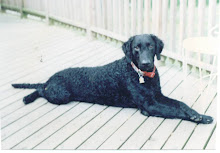
2008 was a very good year.
We ended the year with everyone we started with. Parents, kids, grandkids, brothers, sister, aunts, uncles, nieces, nephews, and dogs. All are healthy, happy and greeting 2009.
We also extended our family quite a bit. Yes, we added Taiko and his littermates and their new families. Taiko is a blast and the extended families are wonderful. They love their new curly kids and they send pictures. We also added Zoomy, a wonderful girl that is settling in nicely. Funny, I went from majority oldsters to majority youngsters in the household and things move much faster now.
Our summer was pretty much taken up with puppies but we did manage to squeeze in a few shows with old and new friends. Ziva was out of coat at every show we attended (and at one show after the pups she had NO curls) but we had fun and she garnered quite a few reserves, so we have hope for the new year if the coat will just coincide with show dates.
Destiny was able to attend every show with me and competed in Juniors at most. I never knew how much fun kids and dog shows could be. We'll be doing more of this in 2009.
We already have training plans for the new year. In January Taiko starts his second obedience class (he is just six months old and will be in formalized training for awhile-I am the one that needs the structure). He will also start obstacle familiarization in agility. Plus, he gets to do field work with the girls. Ziva will continue her obedience training and agility, as well as field work. (We have to take a hiatus from field work in the winter since our training partners are out hunting, duh). Zoomy will take novice obedience classes so that we can develop a mutual rapport. We haven't had time to figure out what she likes to do yet. I'm also hoping to enter someone in a tracking class that starts in the spring so that I can learn the mechanics of it. The old ones will continue to hold their places of honor and share the love.
In spite of all our big plans for the new year, we are most excited by the addition of a new human family member. Due in February, we're expecting a baby girl, call name Riley!
Happy New Year!
Hunter

A true gentleman
Thursday, January 1, 2009

Sunday, October 19, 2008
Destiny and the Junior Dog Judging Contest
To my great delight, Destiny, my 12 year old granddaughter, was a last minute addition to my Louisville show trip. It was too late to enter her in any Junior Showmanship classes but she was able to participate in a junior handling clinic and a Junior Dog Judging Contest.
The announcement came over the loud speaker: Last call for all kids interested in signing up for the Junior Dog Judging Contest. Most of the Juniors pre-entered the contest when they sent in their Junior Showmanship entries and received their packets by mail. When Destiny signed up, she received a packet which contained four breed standards: the Boxer, the Border Collie, the Boston Terrier and the American Staffordshire Terrier. Destiny had never read a breed standard before (not even the Curly). She had exactly 30 minutes to prepare and learn all she could about the four, selected breeds.
It was an interesting competition. An AKC Judge did a show exam of the four or five dogs in each breed presented. His exam included a physical exam and bite, down and back, then around. The Judge ranked the dogs 1st through 4th but did not announce his placements. The Juniors were to try to place the dogs the way the Judge had.
The Juniors were allowed to spread out on two sides of the ring to watch the Judge’s examinations. When the Judge completed his placements, they were invited into the ring for a closer look at each dog while the entry was stacked in the center of the ring. They did not perform a physical examination or further movement exercises. The Juniors wrote their placements on a card and handed it to the Steward as they left the ring. This was repeated for three breeds, the Bostons showed up but didn’t wait around to be examined - they’d already had a long day.
After all breeds had been examined, the Judge conducted a personal interview with each Junior. The Juniors had to explain to the Judge why they put each dog in its particular placement order and what they liked/disliked about each one. During the interview phase, only one breed was discussed, the American Staffordshire Terrier. Some of the Juniors appeared nervous during the interview phase of the competition but Destiny was quite at ease and very animated in explaining what she liked about each dog and why she placed it in the order that she did.
Upon completion of the interviews, the scores were tallied and the Juniors were awarded placements from fourth through first. Out of the 20 or so Juniors who participated, Destiny was awarded second place. She had tied for first in her rankings of the dogs with the personal interview being used as the tie-breaker. Not bad at all for a kid who started "show doggin" 10 months ago.
I do believe she has "the eye" for it.
Originally Published in the June, 2008 Issue of The Curly Commentator, the official publication of the Curly-Coated Retriever Club of America (CCRCA)
Q & A for the day:
How does a youngster learn more about Junior Showmanship?
The American Kennel Club has a Juniors' section on their website at www.akc.org. There are links to the rules and lots of other resources for kids. Juniors are separated by their experience level and their age so that they compete against similarly situated kids.
You can even compete with your spayed or neutered purebred dog, and/or your previously unregistered purebred (with just a few steps to get it a PAL number - info also on the AKC website).
Junior Showmanship is a growing sport and it is fun for the kids that compete. New kids have started at almost every show we've been to. And, a kid that tries hard can compete with the seasoned competitors in no time.
The announcement came over the loud speaker: Last call for all kids interested in signing up for the Junior Dog Judging Contest. Most of the Juniors pre-entered the contest when they sent in their Junior Showmanship entries and received their packets by mail. When Destiny signed up, she received a packet which contained four breed standards: the Boxer, the Border Collie, the Boston Terrier and the American Staffordshire Terrier. Destiny had never read a breed standard before (not even the Curly). She had exactly 30 minutes to prepare and learn all she could about the four, selected breeds.
It was an interesting competition. An AKC Judge did a show exam of the four or five dogs in each breed presented. His exam included a physical exam and bite, down and back, then around. The Judge ranked the dogs 1st through 4th but did not announce his placements. The Juniors were to try to place the dogs the way the Judge had.
The Juniors were allowed to spread out on two sides of the ring to watch the Judge’s examinations. When the Judge completed his placements, they were invited into the ring for a closer look at each dog while the entry was stacked in the center of the ring. They did not perform a physical examination or further movement exercises. The Juniors wrote their placements on a card and handed it to the Steward as they left the ring. This was repeated for three breeds, the Bostons showed up but didn’t wait around to be examined - they’d already had a long day.
After all breeds had been examined, the Judge conducted a personal interview with each Junior. The Juniors had to explain to the Judge why they put each dog in its particular placement order and what they liked/disliked about each one. During the interview phase, only one breed was discussed, the American Staffordshire Terrier. Some of the Juniors appeared nervous during the interview phase of the competition but Destiny was quite at ease and very animated in explaining what she liked about each dog and why she placed it in the order that she did.
Upon completion of the interviews, the scores were tallied and the Juniors were awarded placements from fourth through first. Out of the 20 or so Juniors who participated, Destiny was awarded second place. She had tied for first in her rankings of the dogs with the personal interview being used as the tie-breaker. Not bad at all for a kid who started "show doggin" 10 months ago.
I do believe she has "the eye" for it.
Originally Published in the June, 2008 Issue of The Curly Commentator, the official publication of the Curly-Coated Retriever Club of America (CCRCA)
Q & A for the day:
How does a youngster learn more about Junior Showmanship?
The American Kennel Club has a Juniors' section on their website at www.akc.org. There are links to the rules and lots of other resources for kids. Juniors are separated by their experience level and their age so that they compete against similarly situated kids.
You can even compete with your spayed or neutered purebred dog, and/or your previously unregistered purebred (with just a few steps to get it a PAL number - info also on the AKC website).
Junior Showmanship is a growing sport and it is fun for the kids that compete. New kids have started at almost every show we've been to. And, a kid that tries hard can compete with the seasoned competitors in no time.
Thursday, September 25, 2008
A Delightful Diversion
For the past several weeks we've been fully immersed in another endeavor. We've had puppies!! Six little curlies were born June 27. Watching them grow, morphing from little furballs into little doggies was so much fun. When they were tiny, I could sit by and watch them for hours. As they got bigger, it was more of the same.
Finding the perfect home for each pup was a challenge but worked out wonderfully in the end. Several of the pups will be hunting companions, a couple have children, another couple have grandkids and all will be family companions. It just doesn't get any better than that.
And the little guy that stayed with us . . . he is fabulous!!!
The photo journal of the pups is linked off of our home page but be forewarned, there are a lot of pictures (in case you are prone to puppy fever) and a few videos too.
Finding the perfect home for each pup was a challenge but worked out wonderfully in the end. Several of the pups will be hunting companions, a couple have children, another couple have grandkids and all will be family companions. It just doesn't get any better than that.
And the little guy that stayed with us . . . he is fabulous!!!
The photo journal of the pups is linked off of our home page but be forewarned, there are a lot of pictures (in case you are prone to puppy fever) and a few videos too.
Saturday, June 14, 2008
Needed - longer arms.
One of the perks of owning Curly-Coated Retrievers is the type of games you can play with them. Hunter, my first CCR introduced me to the fun of field training. I joined a great group of folks who had trained other retriever breeds for many years and they were very patient in teaching me the ropes. After awhile, I found the confidence to go out by myself to work on drills.
On one particular occasion, Hunter took extreme advantage of the pond in between us. I had sent him on a blind retrieve across the pond (several bumpers were already placed on the other side so he would see no bumper fall). When he got to the other side, however, he must have figured out that my arms weren't long enough to reach him so he could do as he pleased. And he did. He investigated every interesting smell he could find and peed on lots of things. He was having such a good time that he failed to notice that I was trotting around the pond.
He was so intent on investigating his latest find that until I said "Hunter, Heel!" from two feet away, he didn't even know I was there.
I know I've mentioned his "Oh S#!#!" look before, but this was the first time I ever saw it. He looked directly into my eyes and I could read his mind. He knew that he was in trouble and he instantly tried to fix it by snatching up his bumper and jumping into the pond, heading strait back to the spot where I had been standing on the opposite bank.
"Oh no you don't", I said and I called him to heel. To his credit he came out of the water, tail tucked between his legs and he slunk over to where I stood. He looked so pitiful standing there, dripping wet. He didn't even shake. He knew he was caught. A guilty conscience goes a long way with this dog. And before you wonder, "does he act that way because you beat him?" I can say absolutely not!! We train with praise! Besides, unless you can administer a correction simultaneously with the mis-deed, you may as well save it because the belated correction is totally useless as a teaching tool.
I was having a bit of difficulty not laughing at him so I decided to let him off the hook and put him back to work. I made him hold his bumper and sat him at the edge of the pond. Then I walked back around the pond to my original spot, faced him and from across the water I called, "Hunter Come!"
Now I had great visions of Hunter plunging into the water and swimming to me in a direct line, as he should have done to begin with. Instead, at my call, he took a sharp right turn and ran around the pond in the exact route that I had just taken.
Oh well, I was training blinds, not bank running so I held my tongue since he technically obeyed the command I had given him. After this episode, I decided that we needed to end the training session on a good note so I set him up again, held my breath and sent him "Back" across the pond for the last bumper. This time, he hit the water, swam across, picked up the bumper, turned and swam strait back to me.
Good dog!
Q & A for the day:
Hmmm, two good topics for this one so I'll pick the one folks have the most trouble recognizing - timing the praise or correction.
What do you mean, timing the praise or correction is everything?
I'll start with an example, you are teaching your dog to sit . . . he is right in front of you and you tell him to "sit" . . . and for the first time, his bottom hits the floor . . . you are sooooo excited that you throw your hands up in the air and clap . . . he experiences your delight and jumps up to celebrate with you . . . and you say "Good Dog".
You have just praised your dog for jumping up, not sitting. So the next time you want him to sit, he will remember how much praise he got when you said "sit" for jumping up and he will try to give you the jumping up behavior that he found most rewarding. He won't want to sit.
He's not a 'dumb dog' that can't learn to sit, he is a smart dog that learned what gets him praise and he repeats the action that got it for him. To reinforce the sit behavior, you must administer the praise while his bottom is still on the ground - it takes only seconds to miss the opportunity to praise correctly so you must be ready. If you miss it, say nothing, and try again.
It also helps to know that a dog's attention span for learning new activities can be counted in seconds, 5 - 10 seconds max, depending on age. So if you want to correct him for a misdeed, he must be doing the misdeed at the time of the correction. If you catch him chewing a chair leg, tell him "no chew" or "bad chew" and give him something appropriate to chew on, then follow up with a "good chew" - or whatever words you choose to use. Choice of word doesn't matter as long as you are consistent - it is the voice, not the word that counts - but command consistency helps during the learning process.
This is also why house training can take so long for some dogs. They don't associate a correction received well after the deed is done with actually doing the deed in the house. And shoving his nose in the pile doesn't help - he no longer associates an old pile with the 'doing of the deed'. That is why a crate is very useful in house training. The dog is contained in his den until you can escort him outside - then GO with him so that you can praise his doing the deed outside where you want it. Afterwards, keep a close eye on him and if he starts sniffing around the room, take him out again and if he performs praise him again. In house training, diligence is everything.
Be careful that you don't fall into the house training trap of training the dog to use the revolving door. If you let him out the door, he pees and comes back in, then gets a cookie, no matter what you are saying, in his mind he is being praised for coming inside - not peeing outside. That's why some dogs have to "go" so often - they are really going outside so that they can come right back inside and get a cookie :-). This is exactly why you need to go outside with the dog - so that you can give praise for the correct behavior - peeing, not coming in the door - the praise always comes outside. Lots of folks have spent lots of dollars going to the vet to make sure their dog doesn't have an infection because they always have to 'go'.
You will be amazed at the results you can get if you remember the proper use of these two words: "timing and praise".
On one particular occasion, Hunter took extreme advantage of the pond in between us. I had sent him on a blind retrieve across the pond (several bumpers were already placed on the other side so he would see no bumper fall). When he got to the other side, however, he must have figured out that my arms weren't long enough to reach him so he could do as he pleased. And he did. He investigated every interesting smell he could find and peed on lots of things. He was having such a good time that he failed to notice that I was trotting around the pond.
He was so intent on investigating his latest find that until I said "Hunter, Heel!" from two feet away, he didn't even know I was there.
I know I've mentioned his "Oh S#!#!" look before, but this was the first time I ever saw it. He looked directly into my eyes and I could read his mind. He knew that he was in trouble and he instantly tried to fix it by snatching up his bumper and jumping into the pond, heading strait back to the spot where I had been standing on the opposite bank.
"Oh no you don't", I said and I called him to heel. To his credit he came out of the water, tail tucked between his legs and he slunk over to where I stood. He looked so pitiful standing there, dripping wet. He didn't even shake. He knew he was caught. A guilty conscience goes a long way with this dog. And before you wonder, "does he act that way because you beat him?" I can say absolutely not!! We train with praise! Besides, unless you can administer a correction simultaneously with the mis-deed, you may as well save it because the belated correction is totally useless as a teaching tool.
I was having a bit of difficulty not laughing at him so I decided to let him off the hook and put him back to work. I made him hold his bumper and sat him at the edge of the pond. Then I walked back around the pond to my original spot, faced him and from across the water I called, "Hunter Come!"
Now I had great visions of Hunter plunging into the water and swimming to me in a direct line, as he should have done to begin with. Instead, at my call, he took a sharp right turn and ran around the pond in the exact route that I had just taken.
Oh well, I was training blinds, not bank running so I held my tongue since he technically obeyed the command I had given him. After this episode, I decided that we needed to end the training session on a good note so I set him up again, held my breath and sent him "Back" across the pond for the last bumper. This time, he hit the water, swam across, picked up the bumper, turned and swam strait back to me.
Good dog!
Q & A for the day:
Hmmm, two good topics for this one so I'll pick the one folks have the most trouble recognizing - timing the praise or correction.
What do you mean, timing the praise or correction is everything?
I'll start with an example, you are teaching your dog to sit . . . he is right in front of you and you tell him to "sit" . . . and for the first time, his bottom hits the floor . . . you are sooooo excited that you throw your hands up in the air and clap . . . he experiences your delight and jumps up to celebrate with you . . . and you say "Good Dog".
You have just praised your dog for jumping up, not sitting. So the next time you want him to sit, he will remember how much praise he got when you said "sit" for jumping up and he will try to give you the jumping up behavior that he found most rewarding. He won't want to sit.
He's not a 'dumb dog' that can't learn to sit, he is a smart dog that learned what gets him praise and he repeats the action that got it for him. To reinforce the sit behavior, you must administer the praise while his bottom is still on the ground - it takes only seconds to miss the opportunity to praise correctly so you must be ready. If you miss it, say nothing, and try again.
It also helps to know that a dog's attention span for learning new activities can be counted in seconds, 5 - 10 seconds max, depending on age. So if you want to correct him for a misdeed, he must be doing the misdeed at the time of the correction. If you catch him chewing a chair leg, tell him "no chew" or "bad chew" and give him something appropriate to chew on, then follow up with a "good chew" - or whatever words you choose to use. Choice of word doesn't matter as long as you are consistent - it is the voice, not the word that counts - but command consistency helps during the learning process.
This is also why house training can take so long for some dogs. They don't associate a correction received well after the deed is done with actually doing the deed in the house. And shoving his nose in the pile doesn't help - he no longer associates an old pile with the 'doing of the deed'. That is why a crate is very useful in house training. The dog is contained in his den until you can escort him outside - then GO with him so that you can praise his doing the deed outside where you want it. Afterwards, keep a close eye on him and if he starts sniffing around the room, take him out again and if he performs praise him again. In house training, diligence is everything.
Be careful that you don't fall into the house training trap of training the dog to use the revolving door. If you let him out the door, he pees and comes back in, then gets a cookie, no matter what you are saying, in his mind he is being praised for coming inside - not peeing outside. That's why some dogs have to "go" so often - they are really going outside so that they can come right back inside and get a cookie :-). This is exactly why you need to go outside with the dog - so that you can give praise for the correct behavior - peeing, not coming in the door - the praise always comes outside. Lots of folks have spent lots of dollars going to the vet to make sure their dog doesn't have an infection because they always have to 'go'.
You will be amazed at the results you can get if you remember the proper use of these two words: "timing and praise".
Saturday, June 7, 2008
Million Dollar Babe
In the very, wee hours of the morning (4:30 a.m.), Singer, aka the Babe, my 11 y/o Curly-Coated Retriever, barked and woke me up. Thinking she had to go outside to make a nature call I (very grudgingly) rolled out of bed to let her out. It always irks me when she says one thing then does something else, but once I got up she obviously didn't want to go outside - still, since I was up, and the other girls were creating a ruckus now too, I let them all outside. As I walked back through the house, the doorbell rang, at a time when doorbells should not ring! I hate the adrenaline rush you get when doorbells ring at the wrong time.
I did an immediate about turn and let the girls back in, then went to a window that had a view of the door and there, bent over and peeping in the front door pane, was a shirtless man, that shouldn't have been there. I really hate the adrenaline rush you get when you see shirtless men that shouldn't be there.
My brain left my body at the sight of the man, but somehow I managed to think "shotgun" and I took great comfort in holding it while I dialed 911. The man was gone by the time the police came.
We'll never know what plans the prowler had, if any, but thanks to the Babe, we're safe. Now the other girls were probably helping too, but since Singer barked first and woke me up, she gets the credit. Deacon was in another part of the house so he didn't get to help. He is my second line of defense if anyone gets past the girls.
The Babe - a million dollars. . . sleeping through the night under her watchful eye/ear, priceless.
I did an immediate about turn and let the girls back in, then went to a window that had a view of the door and there, bent over and peeping in the front door pane, was a shirtless man, that shouldn't have been there. I really hate the adrenaline rush you get when you see shirtless men that shouldn't be there.
My brain left my body at the sight of the man, but somehow I managed to think "shotgun" and I took great comfort in holding it while I dialed 911. The man was gone by the time the police came.
We'll never know what plans the prowler had, if any, but thanks to the Babe, we're safe. Now the other girls were probably helping too, but since Singer barked first and woke me up, she gets the credit. Deacon was in another part of the house so he didn't get to help. He is my second line of defense if anyone gets past the girls.
The Babe - a million dollars. . . sleeping through the night under her watchful eye/ear, priceless.
Sunday, May 18, 2008
She climbs trees
The first time ever I saw her climb . . . (ok, I went lyrical because her name is Singer).
We had traveled to Flora, Mississippi (near Jackson) to run an AKC hunt test conducted by the Magnolia Hunting Retriever Club. Singer, my Curly-coated Retriever, was 9 1/2 months old and needed to pass the test to earn her AKC Junior Hunter (JH) title.
For those who don't know, at the Junior level, two judges and the dog and handler stand at the line, a bird goes down and the dog is sent to pick it up immediately. The dog must pick up two individual retrieves on land and two on water and they are graded in several areas in order to pass the test. They must pass four tests to earn the JH title.
No water test is ever "easy" when you are the one standing at the line, but this one was stacked against the Babe. First, as she swam through the "flock" of decoys, she got tangled in one decoy's line and dragged it across the pond, continuing towards her bird as though the decoy wasn't even there. She shook the decoy at the bank, picked up her bird and retraced her path, strait back to me through the water.
Then, on the second mark, the bird was supposed to be thrown in the water just behind a fallen tree that was designed to be an obstacle in the direct line between the dog and the fall. The bird was thrown, and Singer began her swim towards the fall, and by necessity, the tree.
When she reached the tree, however, instead of swimming around it as the other dogs had done, she swam directly into it (there was no easy path through it). Then, she started trying to climb it . . . she would hook her front legs over a limb, move them up to a higher limb, pull her back legs onto the first limb . . . and sink back into the water, as the lower limbs had no resistance in the water to help hold her weight. This was repeated several times, but she wouldn't give up. She kept trying to get high enough to break free of the water.
Back on the line, the judges and I kept trying to figure out what she was doing. We thought she'd gone nutz! And I was trying to decide whether it was time to call her in (knowing she wouldn't come back without a bird). I didn't want to go swimming to get her and the judges never said "pick up your dog" so I waited. And she just kept trying to climb that tree.
After what seemed like an eternity (time stands still on the line), but more like one or two minutes, she broke water and literally climbed about four feet into the tree. She came down with her duck! Unbeknownst to anyone, the bird had accidently been thrown into the crown of the fallen tree - we had all watched it go down but assumed it had fallen into the water behind the tree. My little girl watched it go down too, and she followed the mark and her nose . . . into the tree, and she didn't give up until she got her bird.
Afterwards, I accused the judges of trying to sabotage her tests because she was curly. They laughed, but they were amazed by her performance.
Over time, Singer has climed into a few more bushes and trees looking for things real or imagined. And I smile every time I pass those bright orange ribbons that remind me of the tense moments as I watched the nutty little Curly try to climb a tree.
Q & A for the day:
How can I get my retriever involved in training and running a hunt test?
I'll say this first - you are looking at spending hours training, gas traveling and cash for the accessories. You may make friends with folks who do the same thing. And, if you get hooked, you'll be doing it a lot more. You might even find yourself trading in your car for a vehicle that can carry your dog and your "stuff" - I moved up after a few years. I managed quite well using two folding General crates and a sun shield, operating from the trunk of my Thunderbird (and there weren't that many places that I couldn't get to in the car).
Hunters use training for hunt tests to keep their dogs conditioned during the off season. Others participate for the pleasure of the sport. So there are usually people out training in many areas for a number of reasons.
Sometimes, you can see folks out training and you can walk up, introduce yourself and express your interest in getting started. (In the summer, look for them at dawn when the day is still cool - they're usually done by mid-morning.) They may or may not be helpful, but you can usually get the name of someone to contact who will be helpful. Don't confuse 'hot and tired' with indifference, although you may see either, but you can still get that name.
You can also ask your other dog associates - e.g. someone at the obedience, agility or conformation club will know who trains their retrievers. Or, you might check at the sporting goods store that carries dog training equipment. You may find them at work or at church, you just have to ask (or check the parking lot for vehicles with dog crates and DU decals). You get the picture.
In today's information age, clubs are pretty easy to find. When you contact a local club, you can usually find out who is training in your area. Many clubs actively mentor newcomers and will put you in touch with someone who can help you get started.
The Amercan Kennel Club lists their test-giving clubs on their website at http://www.akc.org/clubs/search/index.cfm?action=perf&display=on,
just select "hunting tests" and your state. A contact for each club is listed. If you have to write, send your email address and a phone number to make it easier for them to contact you.
The United Kennel Club (UKC) lists their clubs as well at http://www.ukcdogs.com/Clubs.nsf/ClubViewHRC?Open&Start=1&Count=30&Type=HRC&List=A
In my opinion, the UKC tests are the most fun and realistic (patterned after actual hunting scenarios and emphasizing gun safety) to run.
The North American Hunting Retriever Association lists member clubs at http://www.nahranews.com/html/nahra/clublist.htm These folks are not everywhere but I've heard good things about their tests.
There are also pro-trainers out there (both good and bad - interview them like you would a nanny for your child) but I don't recommend going that route, at least until you determine that you like the sport enough to become involved in it. All of my dogs have been owner trained and handled. I love the sport and have nothing to prove that would require the use of a pro trainer.
We had traveled to Flora, Mississippi (near Jackson) to run an AKC hunt test conducted by the Magnolia Hunting Retriever Club. Singer, my Curly-coated Retriever, was 9 1/2 months old and needed to pass the test to earn her AKC Junior Hunter (JH) title.
For those who don't know, at the Junior level, two judges and the dog and handler stand at the line, a bird goes down and the dog is sent to pick it up immediately. The dog must pick up two individual retrieves on land and two on water and they are graded in several areas in order to pass the test. They must pass four tests to earn the JH title.
No water test is ever "easy" when you are the one standing at the line, but this one was stacked against the Babe. First, as she swam through the "flock" of decoys, she got tangled in one decoy's line and dragged it across the pond, continuing towards her bird as though the decoy wasn't even there. She shook the decoy at the bank, picked up her bird and retraced her path, strait back to me through the water.
Then, on the second mark, the bird was supposed to be thrown in the water just behind a fallen tree that was designed to be an obstacle in the direct line between the dog and the fall. The bird was thrown, and Singer began her swim towards the fall, and by necessity, the tree.
When she reached the tree, however, instead of swimming around it as the other dogs had done, she swam directly into it (there was no easy path through it). Then, she started trying to climb it . . . she would hook her front legs over a limb, move them up to a higher limb, pull her back legs onto the first limb . . . and sink back into the water, as the lower limbs had no resistance in the water to help hold her weight. This was repeated several times, but she wouldn't give up. She kept trying to get high enough to break free of the water.
Back on the line, the judges and I kept trying to figure out what she was doing. We thought she'd gone nutz! And I was trying to decide whether it was time to call her in (knowing she wouldn't come back without a bird). I didn't want to go swimming to get her and the judges never said "pick up your dog" so I waited. And she just kept trying to climb that tree.
After what seemed like an eternity (time stands still on the line), but more like one or two minutes, she broke water and literally climbed about four feet into the tree. She came down with her duck! Unbeknownst to anyone, the bird had accidently been thrown into the crown of the fallen tree - we had all watched it go down but assumed it had fallen into the water behind the tree. My little girl watched it go down too, and she followed the mark and her nose . . . into the tree, and she didn't give up until she got her bird.
Afterwards, I accused the judges of trying to sabotage her tests because she was curly. They laughed, but they were amazed by her performance.
Over time, Singer has climed into a few more bushes and trees looking for things real or imagined. And I smile every time I pass those bright orange ribbons that remind me of the tense moments as I watched the nutty little Curly try to climb a tree.
Q & A for the day:
How can I get my retriever involved in training and running a hunt test?
I'll say this first - you are looking at spending hours training, gas traveling and cash for the accessories. You may make friends with folks who do the same thing. And, if you get hooked, you'll be doing it a lot more. You might even find yourself trading in your car for a vehicle that can carry your dog and your "stuff" - I moved up after a few years. I managed quite well using two folding General crates and a sun shield, operating from the trunk of my Thunderbird (and there weren't that many places that I couldn't get to in the car).
Hunters use training for hunt tests to keep their dogs conditioned during the off season. Others participate for the pleasure of the sport. So there are usually people out training in many areas for a number of reasons.
Sometimes, you can see folks out training and you can walk up, introduce yourself and express your interest in getting started. (In the summer, look for them at dawn when the day is still cool - they're usually done by mid-morning.) They may or may not be helpful, but you can usually get the name of someone to contact who will be helpful. Don't confuse 'hot and tired' with indifference, although you may see either, but you can still get that name.
You can also ask your other dog associates - e.g. someone at the obedience, agility or conformation club will know who trains their retrievers. Or, you might check at the sporting goods store that carries dog training equipment. You may find them at work or at church, you just have to ask (or check the parking lot for vehicles with dog crates and DU decals). You get the picture.
In today's information age, clubs are pretty easy to find. When you contact a local club, you can usually find out who is training in your area. Many clubs actively mentor newcomers and will put you in touch with someone who can help you get started.
The Amercan Kennel Club lists their test-giving clubs on their website at http://www.akc.org/clubs/search/index.cfm?action=perf&display=on,
just select "hunting tests" and your state. A contact for each club is listed. If you have to write, send your email address and a phone number to make it easier for them to contact you.
The United Kennel Club (UKC) lists their clubs as well at http://www.ukcdogs.com/Clubs.nsf/ClubViewHRC?Open&Start=1&Count=30&Type=HRC&List=A
In my opinion, the UKC tests are the most fun and realistic (patterned after actual hunting scenarios and emphasizing gun safety) to run.
The North American Hunting Retriever Association lists member clubs at http://www.nahranews.com/html/nahra/clublist.htm These folks are not everywhere but I've heard good things about their tests.
There are also pro-trainers out there (both good and bad - interview them like you would a nanny for your child) but I don't recommend going that route, at least until you determine that you like the sport enough to become involved in it. All of my dogs have been owner trained and handled. I love the sport and have nothing to prove that would require the use of a pro trainer.
Thursday, May 8, 2008
A soft mouth
Deacon, my Curly-Coated Retriever, has a very soft mouth. Since he was not actively field training, I might have missed this fact except for an incident that happened one spring morning.
Every morning the dogs run outside in a fenced back yard then come in and hang out with me for awhile before I have to go to work. One morning, after the dogs had been back inside for about half an hour I noticed that unmistakable look on Deacon's face and knew that he was hiding something in his mouth. You know the look, the cheeks kind of puff out and it's the only time that he isn't under foot.
Fearing the worst, I stuck out my hand and said "Give!". He hesitated for a few moments then moved to give me his prize. Very gently, he placed an object in my hand. . . a bird. . . a baby bird . . . a tiny, featherless baby bird. . . that was now opening and closing its mouth waiting for "mama" to provide the next meal. The baby bird had been comfortably hiding in his mouth for half an hour.
I didn't have the heart to tell Mama Deacon that his baby would not survive. . . it was too young to survive without a real mother bird. We went out and looked for a nest but there was none to be found. We left the baby where its mother could find it if she was looking for it and went back inside.
Also see: Soft Mouth; Can You Train It posted on this blog on 01/17/2010.
Q & A for the Day:
So, what is a soft mouth in retriever lingo?
The dog must have a firm grip to hold a bird, from a small dove to a large goose. The soft mouth is best evidenced by what the dog delivers to you. . . a bird without teeth marks or crush injuries (from the dog's jaw). A soft mouth is evidenced by a firm hold with no chewing or chomping. The bird has usually been shot so there will be blood, but the retriever should not be enticed by the blood to determine that the bird should become his own dinner (yes, it happens). There is some confusion with this point, though, because a soft mouthed dog can also decide to eat the bird, but that is usually a training issue.
A well trained retriever is a great conservation tool. Hunters who take their daily limit without a good retriever (human or canine :-) have probably left several dead birds at the hunt site because they couldn't reach or find them. A good hunting dog will retrieve every bird that falls so there are no unnecessary kills required to meet the limit.
For those hunters that "kill" more than the legal limit so they can leave with a limit. . . shame on them. Every bird down counts. If they want to take them all home, they should get a good 'huntin dawg'.
Every morning the dogs run outside in a fenced back yard then come in and hang out with me for awhile before I have to go to work. One morning, after the dogs had been back inside for about half an hour I noticed that unmistakable look on Deacon's face and knew that he was hiding something in his mouth. You know the look, the cheeks kind of puff out and it's the only time that he isn't under foot.
Fearing the worst, I stuck out my hand and said "Give!". He hesitated for a few moments then moved to give me his prize. Very gently, he placed an object in my hand. . . a bird. . . a baby bird . . . a tiny, featherless baby bird. . . that was now opening and closing its mouth waiting for "mama" to provide the next meal. The baby bird had been comfortably hiding in his mouth for half an hour.
I didn't have the heart to tell Mama Deacon that his baby would not survive. . . it was too young to survive without a real mother bird. We went out and looked for a nest but there was none to be found. We left the baby where its mother could find it if she was looking for it and went back inside.
Also see: Soft Mouth; Can You Train It posted on this blog on 01/17/2010.
Q & A for the Day:
So, what is a soft mouth in retriever lingo?
The dog must have a firm grip to hold a bird, from a small dove to a large goose. The soft mouth is best evidenced by what the dog delivers to you. . . a bird without teeth marks or crush injuries (from the dog's jaw). A soft mouth is evidenced by a firm hold with no chewing or chomping. The bird has usually been shot so there will be blood, but the retriever should not be enticed by the blood to determine that the bird should become his own dinner (yes, it happens). There is some confusion with this point, though, because a soft mouthed dog can also decide to eat the bird, but that is usually a training issue.
A well trained retriever is a great conservation tool. Hunters who take their daily limit without a good retriever (human or canine :-) have probably left several dead birds at the hunt site because they couldn't reach or find them. A good hunting dog will retrieve every bird that falls so there are no unnecessary kills required to meet the limit.
For those hunters that "kill" more than the legal limit so they can leave with a limit. . . shame on them. Every bird down counts. If they want to take them all home, they should get a good 'huntin dawg'.
Subscribe to:
Posts (Atom)